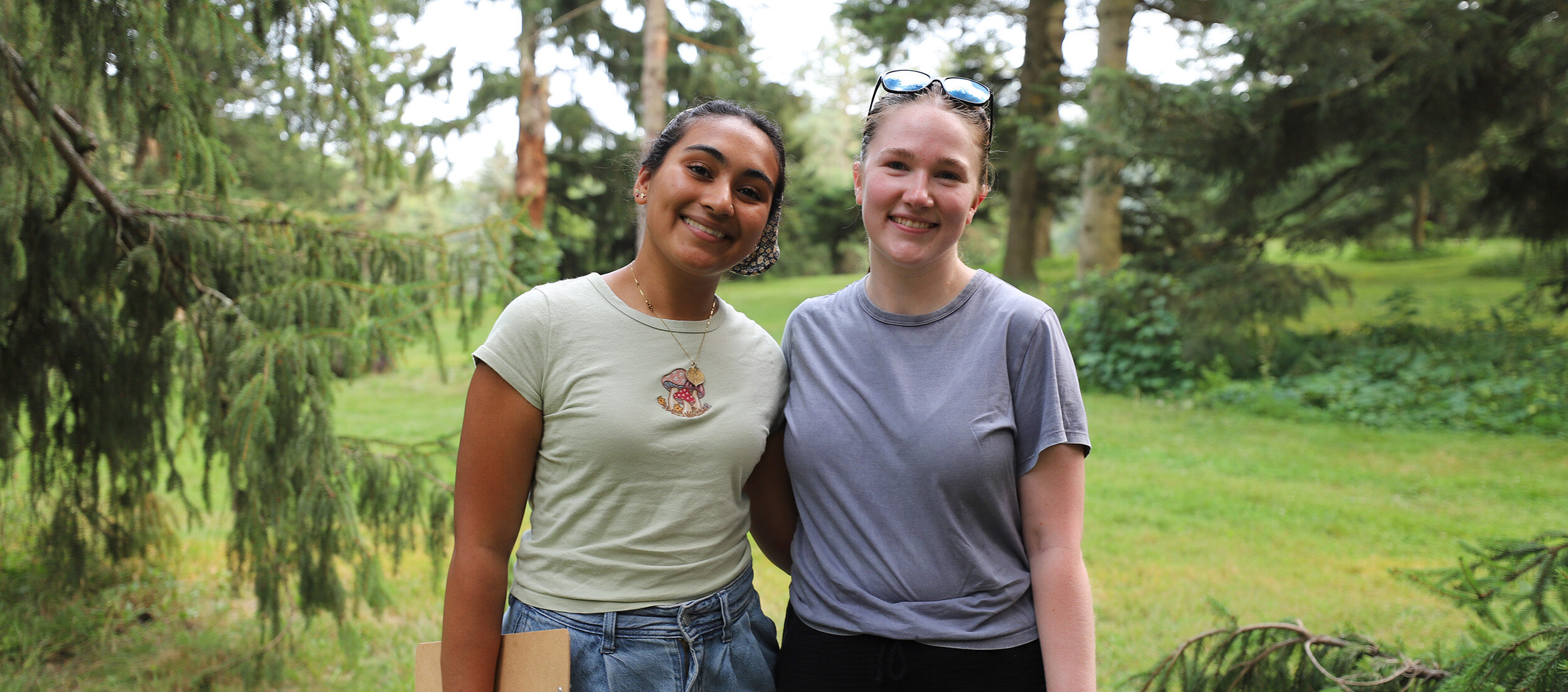
On a mid-July afternoon, Aunnesha Bhowmick and Erica Kirchhof, two 2021 alums of the Arnold Arboretum’s undergraduate research internship program, lead a Tree ID Scavenger Hunt for our latest cohort of interns. While they might have imagined temperatures in the high 90s to be a possibility when they planned the activity, they did not anticipate that the landscape would smell like a campfire. They also did not expect to see a foreboding scarlet sun peeking through a hazy sky or to feel burning eyes and throats from the smoke of Canadian forest fires. Nevertheless, these past and present interns persist in their work, gathering first in the conifer collection and then on Peters Hill to practice tree species identification—cognizant of the trees perishing across wide swaths to the north.
After a summer of record-breaking heatwaves, extreme weather, and forest fires, supporting the next generation of plant scientists feels more essential than ever. The Arboretum’s research internship provides a unique 10-week opportunity for undergraduate college students from around the world to study plants, ecosystems, and global change as they conduct an independent research project in a supportive environment. With hands-on learning and mentorship from faculty and staff, the program increases the expertise and confidence of participants in conducting, analyzing, and sharing science. The active alumni network, including Tree ID Scavenger Hunt organizers Aunnesha and Erica, provides another critical layer of engagement and inspiration for our research interns.
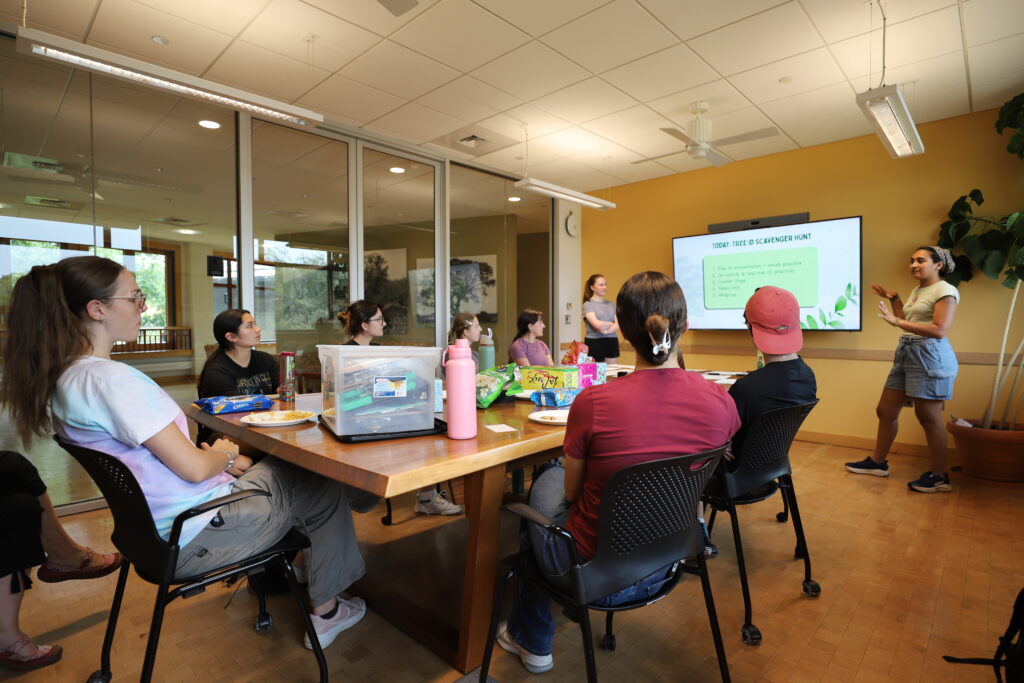
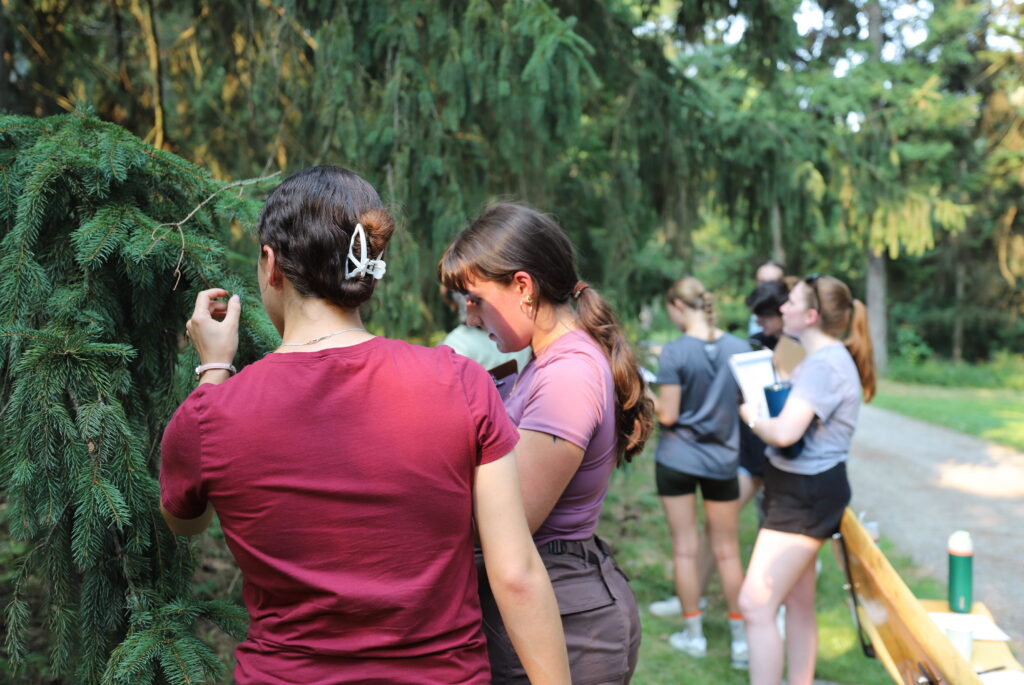
Armed with tree ID books and a competitive spirit, pairs and trios of interns dart around the Arboretum’s hillsides, racing to accurately identify the most tree species in the time provided. Hands-on learning like this scavenger hunt is part of what makes the program special. Instead of spending the whole summer siloed at their desks, interns experience an array of experiences, including herbarium and greenhouse tours, Q&A lunches with visiting researchers, and scriptwriting and filming to practice science communication through digital media.
Under the guidance of Dr. Faye Rosin, director of research facilitation and head of the internship program, interns are matched with an alumni mentor to offer support throughout the summer. “Faye does a great job of staying in touch with alumni, and encouraging us to stay in touch with each other,” Aunnesha shares. “When we found out that both of us were interested in coming back to the Arboretum to run an intern activity, we decided it would be fun to co-lead together.”
Aunnesha, Erica, and the other members of the 2021 intern cohort had a unique internship experience because most of the program was held virtually due to the pandemic. Still, the group bonded and remains connected to each other and the program. “It’s a small plant world, so it’s nice to have a network,” Erica explains.
Both Aunnesha and Erica continue to work with trees, but each took a different path. Aunnesha is director of youth programs at Green Cambridge, a local environmental education nonprofit. She plans and implements nature-based internships on urban forestry and ecology for high school students in Cambridge. Her contagious passion for trees and her gift for teaching are evident as she encourages the scavenger hunters, offering pithy memory prompts such as “Spruces are spikey. Firs are friendly and flat.”
While many Arboretum research interns have gone on to pursue careers influenced by their summer research experiences, the internship’s impact is particularly evident for Erica. Currently she is a PhD student in the Al Kovaleski lab at the University of Wisconsin, Madison—the same researcher (an Arboretum Putnam Fellow) she worked with during her Arboretum internship. Building on questions she first explored then, Erica is now investigating how plants adapt to freezing temperatures and other winter stresses, deepening our understanding of the traits that help species thrive in changing climates.
Like Aunnesha, Erica showcases her tree expertise as she monitors the scavenger hunt, offering the participants some helpful pointers. “This one’s a Prunus. See the distinct lenticels?” Erica gestures at the raised areas on a tree trunk on the grassy slope of Peters Hill. While completely normal, the lenticels make the American plum tree’s bark look scarred and calloused. With its crispy leaves looking almost gray in the smog, the tree seems hardened to the world, but the ring of eager and energized college students surrounding it evokes a glimmer of hope through the smoke.
At the conclusion of the scavenger hunt, the group gathers around a table to review what they learned from this experience. One intern shares that the afternoon has reaffirmed her love for nature and being outside: “I definitely want a job that’s outdoors with plants,” she proclaims. The very next intern shares a polar-opposite realization, announcing their preference for working in the lab, with controlled temperatures and air quality. The exchange highlights a key value of the program—illuminating the variety of experiences in plant science to help students discover their own professional calling, whether in academia, research, green energy, conservation, or another field.
A couple days after the scavenger hunt, the Canadian wildfires were contained, the smoke dispersed, and there were blue skies over Boston once again. A few weeks later, the interns also scattered, returning to their respective universities with greater scientific knowledge, research skills, and confidence, plus an invaluable professional network including Faye, Aunnesha, and Erica. While forest fires, draughts, pollution, and biodiversity loss are ongoing threats to trees, the Arnold Arboretum’s summer research interns prove themselves to be tenacious problem solvers and collaborators, eager to join their predecessors in the fight for the future of plants.
If you are inspired by the Arboretum’s critical work in research training and education—past, present, and future—please consider making a gift to our annual appeal. For questions about sponsoring the Arnold Arboretum’s research internship program please contact Tanya M. Holton at tholton@fas.harvard.edu or 617.384.5043.