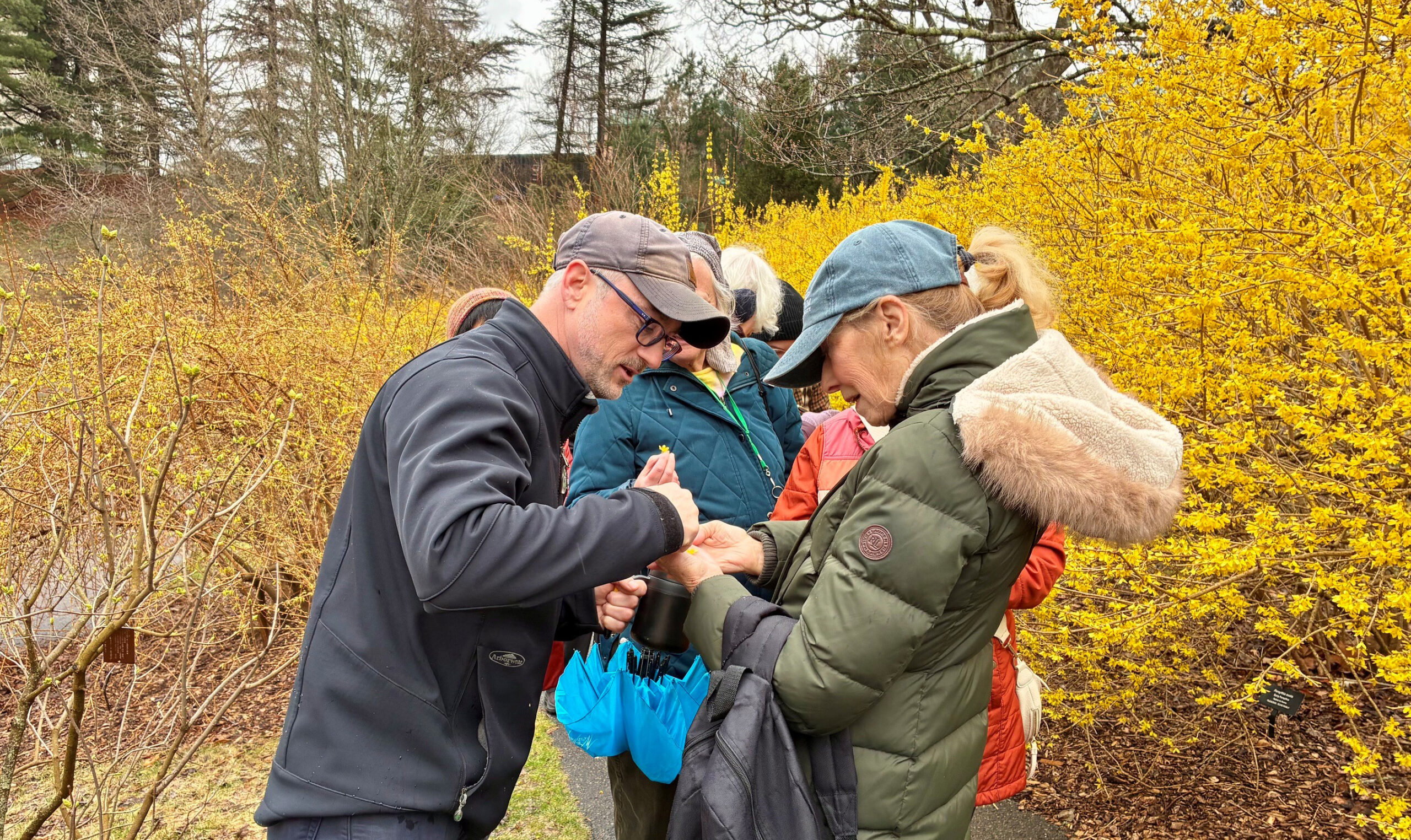
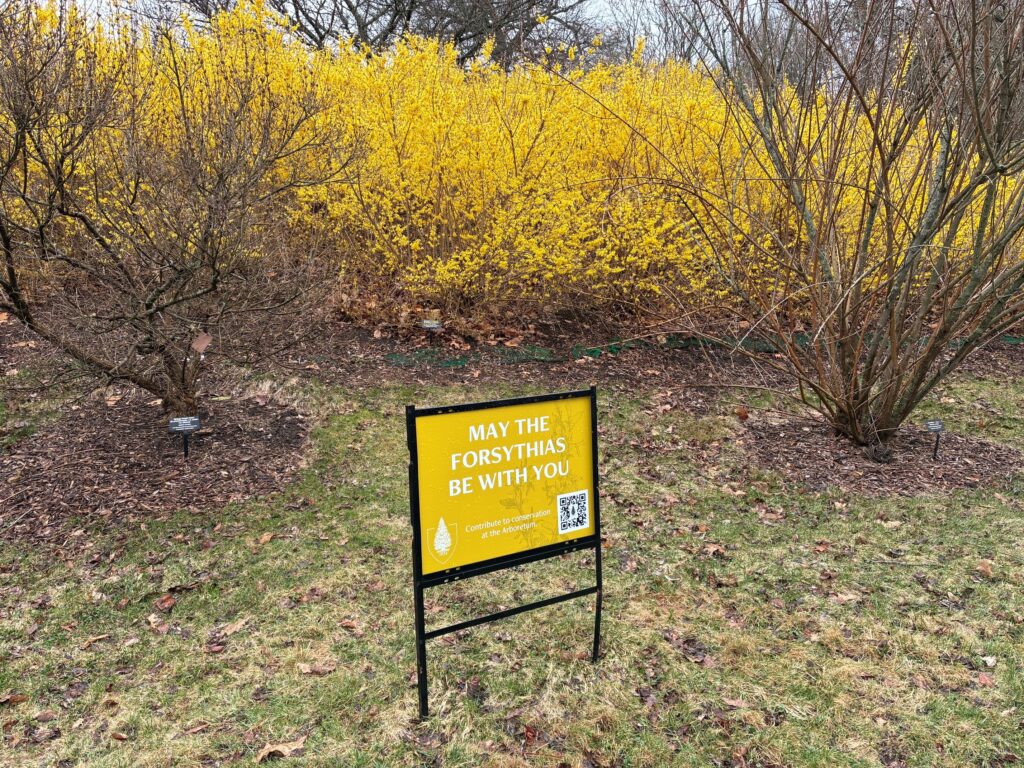
In between scattered April showers, Arnold Arboretum members are drawn to the vibrant glow of the forsythia collection, its sunshine hues cutting through a gloomy gray day. To the untrained eye, the collection at the base of Bussey Hill Road can look like a uniform sea of yellow—but Keeper of the Living Collections and leader of this forsythia Tree Mob, Michael Dosmann, catalogs the diversity of the Arboretum’s collection for his audience. “All forsythias are yellow, but if you look closely, there’s so much variety—some are lemon, some egg yolk, some have a greenish tint, and so on,” he shares. “It’s one of our eight nationally accredited collections, and a valuable ‘library of forsythias’ that people study around the world.”
The Arboretum’s membership community is similarly inclusive and wide-ranging. Some are seasoned gardeners, and others are just dipping their toes into the world of plants. Each member on hand has a story of how they wound up at this particular Tree Mob. Some have been members a long time, like Daniel Scanlan, who grew up nearby and shared stories of his childhood in the landscape. Daniel has supported the Arboretum since the 1970s!
On the other end of the spectrum, new member Caiti Borruso shares that she joined explicitly for this tour, forsythias being her favorite flower. Another new member, Neethu Manoharan, admits that she is new to the world of horticulture but eager to learn and spend more time outside in nature.
Michael weaves together the stories of the Arboretum and forsythia, sharing tales of the sunny plant’s discovery, collection, and cultivation. Most forsythias are native to east Asia, but in the late nineteenth century, a single European species, Forsythia europea, was discovered in the Balkans. This European species has yet to catch on in cultivation, as it is less ornamental than its cousins from the Far East.
On an Arnold Arboretum expedition to Korea in 1917, famed plant explorer Ernest Henry Wilson collected the notably hardy Forsythia ovata, later used for breeding hybrids to capitalize on its cold-hardy genetics. Michael points out a Forsythia suspensa that was collected by Arboretum staff in China over 100 years later in 2018—a weeping variety cultivated to cascade over temple walls.
Most forsythia ranges do not overlap in the wild, and many have a natural chromosome barrier that prevents organic crossing. However, Karl Sax—Harvard professor, botanist, and past Arboretum Director—worked on forsythia hybridization at the Arnold in the 1930s, altering the chromosomes of various specimens to allow certain varieties to cross-pollinate.
One such “Frankenstein” forsythia is Forsythia ‘Meadowlark,’ a cross of two exceptionally hardy species (F. ovata and F. europea). A seedling from the cross made it out into the landscape, bearing the parents’ names, and remained unnoticed amid the mass of yellow. “Thirty years later, after a bitter winter that killed many fragile flower buds, Arboretum horticulturist Harrison Flint noticed a lone forsythia survivor,” Michael explains. “When he investigated the specimen, Harrison realized it was one of Sax’s crosses from decades before.”
Harrison helped establish it as one of the hardiest forsythias around, a distinction that holds to this day. Later, Harrison became a professor of horticulture at Purdue University, where he taught and mentored Michael himself. “He’s actually the person who encouraged me to work in public gardens,” Michael shares, bringing the story full circle.
While the showcased plant collection varies from Tree Mob to Tree Mob, the passion and knowledge of our tour leaders are ever-present, as is the enthusiasm of our members to learn and explore. Our members seize the opportunity for questions, asking for tips on how to get forsythia seeds to germinate in their home gardens, querying the best soil type and moisture levels for forsythias, and inquiring, how does plant crossing actually work?
The opportunity to have the attentive ear of an Arboretum expert is invaluable, and Michael gives detailed answers, like how to use tweezers and a hand lens to introduce pollen manually. Michael even shares the latest news from his plant exploration trips—including late breaking information from the field. “But don’t go around sharing that!” he exclaims with a smile, and I scratch it from my notes. What happens on a Tree Mob stays on a Tree Mob.
Michael concludes the tour by highlighting a forsythia relative—sometimes called “white forsythia” though it belongs to a different genus: Abeliophyllum, a similar-looking shrub with fragrant, white-to-pinkish flowers. Both genera are in the Oleaceae (olive) family, along with lilacs, ash trees, fringetrees, jasmine, and of course, olive trees. “Abeliophyllum is super rare, native only to the Korean peninsula,” Michael emphasizes. He encourages the group to lean in to smell the delicately sweet fragrance of this endangered plant—no passport or plane ticket required.
The rain has held off, and the audience is still deeply engaged. They gather around Michael with additional questions, and Michael answers with aplomb, concluding a quintessential afternoon of what the Arnold Arboretum does best—connecting plants and people. Now Tree Mob veteran Daniel and new members Caiti and Neethu hope to come back for future opportunities to commune with our living collections in all seasons. “When is the next Tree Mob?” Caiti asks. If you are interested in attending a future Tree Mob (this summer’s upcoming offerings include turtles and lightning protection for our arborists), become an Arnold Arboretum member today!