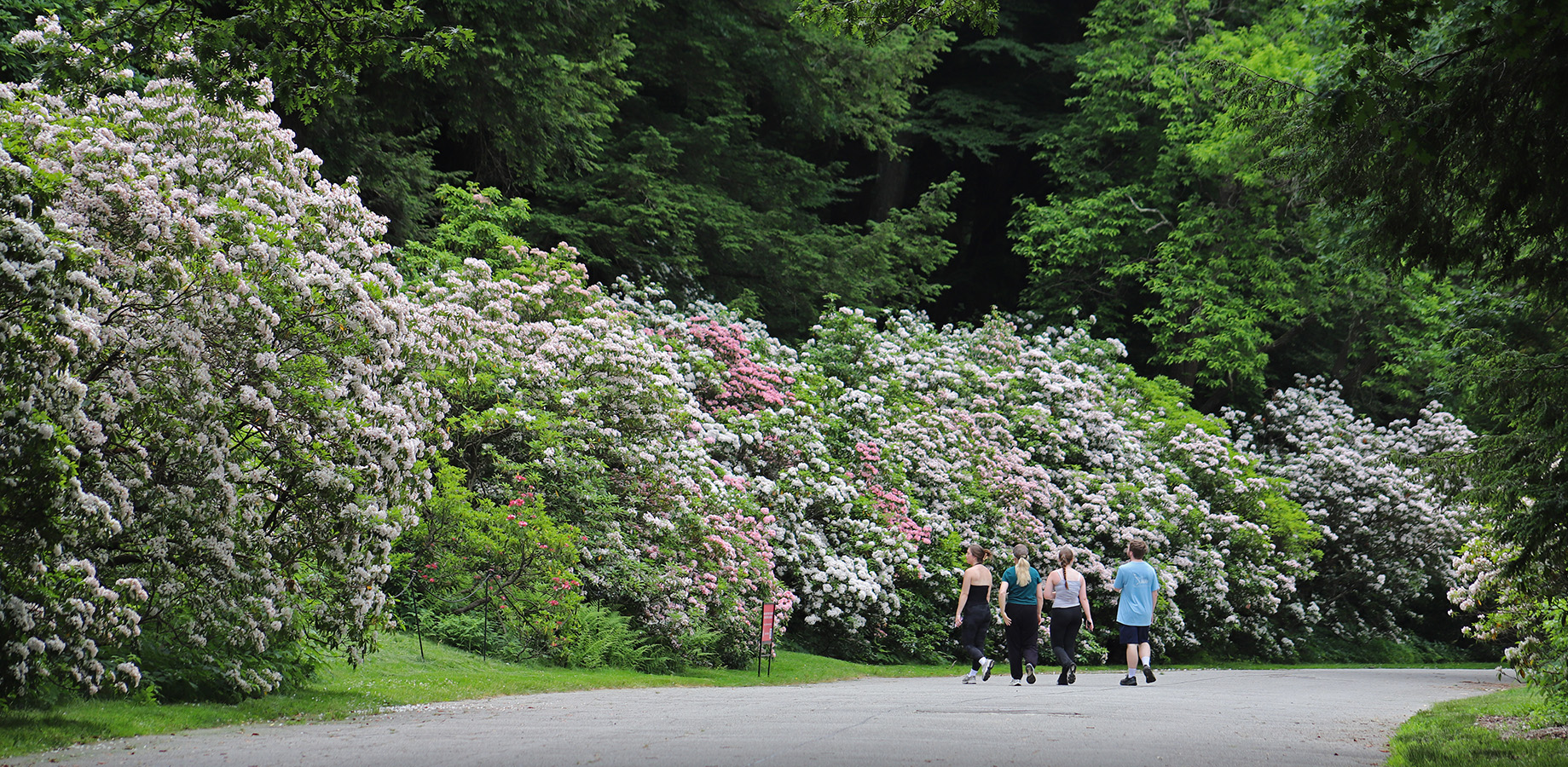
Along the northwestern base of Hemlock Hill at the Arnold Arboretum of Harvard University, a broad sweep of mountain laurel (Kalmia latifolia) grows where the woodland slopes down to meet the historic carriage road. Each June, in the filtered light beneath the hemlocks, these massed plantings offer one of the Arboretum’s most spectacular seasonal spectacles.
A 22-acre woodland shaped by storm, succession, and scientific study, Hemlock Hill offers a rich diversity of shade-loving plants along its lower contours. Among them, mountain laurels are planted in extensive masses that flower profusely as spring transitions to summer. These evergreen shrubs, native to eastern North America from the south coast of Maine to the Florida panhandle, thrive in the acidic soils and dappled understory here, the environment echoing their natural habitat of rocky slopes and forested hillsides. Their pale pink and white blossoms—intricately patterned and arranged in clusters—hover above glossy foliage, transforming the woodland edge into a luminous border.
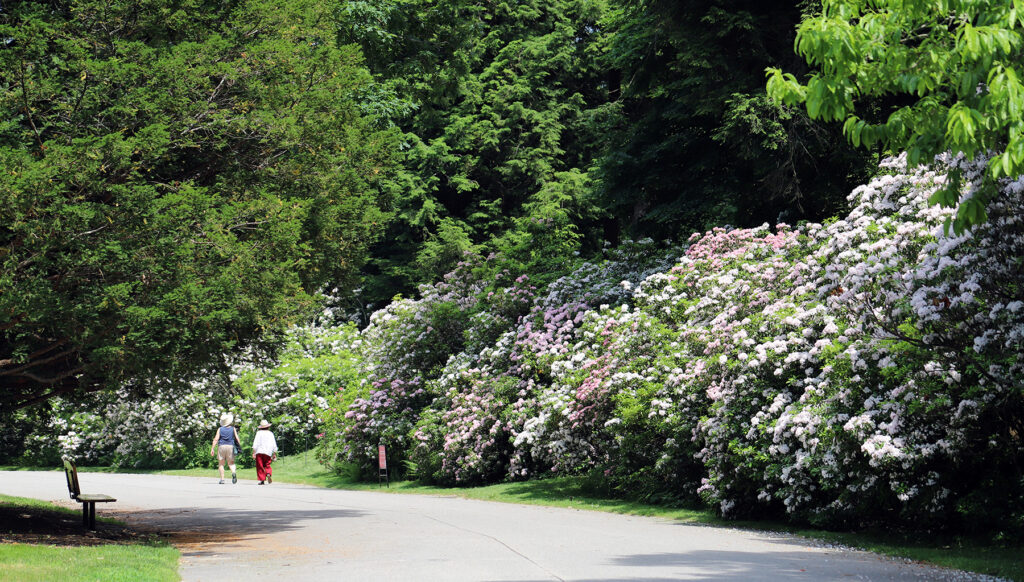
The first mention of mountain laurel in the Arboretum’s plant records is a plant grown from seed collected in West Gloucester, Massachusetts by famed Arboretum plant propagator Jackson Dawson, and accessioned in January 1876. Today the living collection includes many individuals of mountain laurel belonging to 39 accessions, and the display at Hemlock Hill has long been admired and celebrated. In the Arboretum’s early Bulletin of Popular Information, a precursor to Arnoldia, the mountain laurels were described as “the last of the great Arboretum flower shows of the year,” admired by many as “the most beautiful of all North American shrubs.” Each June, their blooms marks a seasonal turning point, closing the parade of spring flowering trees and shrubs with a flourish.
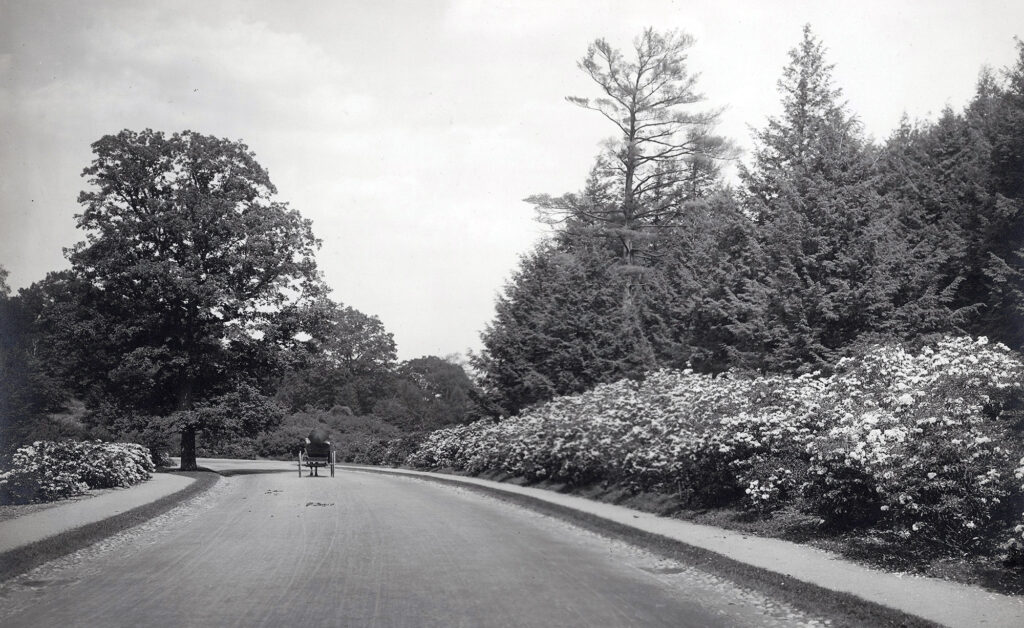
Director William (Ned) Friedman, in his Posts from the Collections, has reflected on this continuity of experience. Comparing archival postcards from the early twentieth century with present-day views, he noted the “seemingly endless stretch of whites, pinks, and even reds at the base of Hemlock Hill,” a scene that has changed in subtle ways as the surrounding forest has matured. The Kalmia shrubs themselves tell part of that story: their branches reaching outward, even “trying to outrun the encroaching shade of the hemlocks behind them.”

Beyond their delicate beauty, mountain laurel blossoms invite closer observation. Each flower is a finely tuned mechanism for pollination, its spring-loaded stamens releasing pollen onto visiting insects. Once pollinated, the showy cups give way to a quieter transformation: the petals fade and fall, and small, rounded fruits begin to form in their place. Over the course of the summer, these develop into dry, brown capsules that will mature in autumn and release clouds of tiny seeds.

in flower. Flowers of a normal (“wild-type”) K. latifolia are seen at far left in the photo.Kyle Port
A noteworthy exception to this distinctive floral anatomy can be seen in the remarkable mutant form Kalmia latifolia ‘Polypetala,’ in which the petals are separated rather than fused into the typical saucer-like cup. This form was first described by Harvard Professor of Botany Asa Gray in 1870 from a plant collected by Mary Bryant of South Deerfield, Massachusetts—several grafted individuals received by the Arboretum in 1885 still survive in our living collection. Rarely encountered in the wild, this variant offers fascinating insight into the species’ developmental biology and the genetic diversity that can arise spontaneously in natural populations.
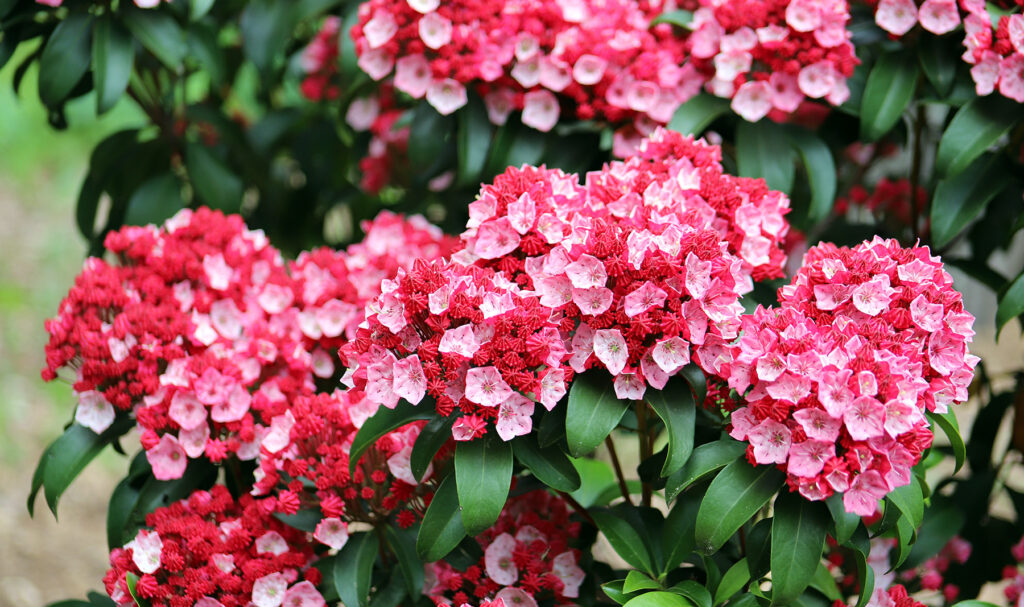
Visitors to our Kalmia collection today can view ‘Polypetala’ and several other interesting cultivars of mountain laurel, including ‘Firecracker’ with its stunning carmine floral buds and deep red blossoms. Together with accessions representing wild-collected specimens from across the species’ native range, these plants reflect the Arboretum’s commitment to conserving natural geographic variation as well as choice examples of horticultural selection. The mountain laurels the Arnold Arboretum are not only a seasonal highlight in our landscape but also a living thread connecting past observations, present stewardship, and future inquiry.