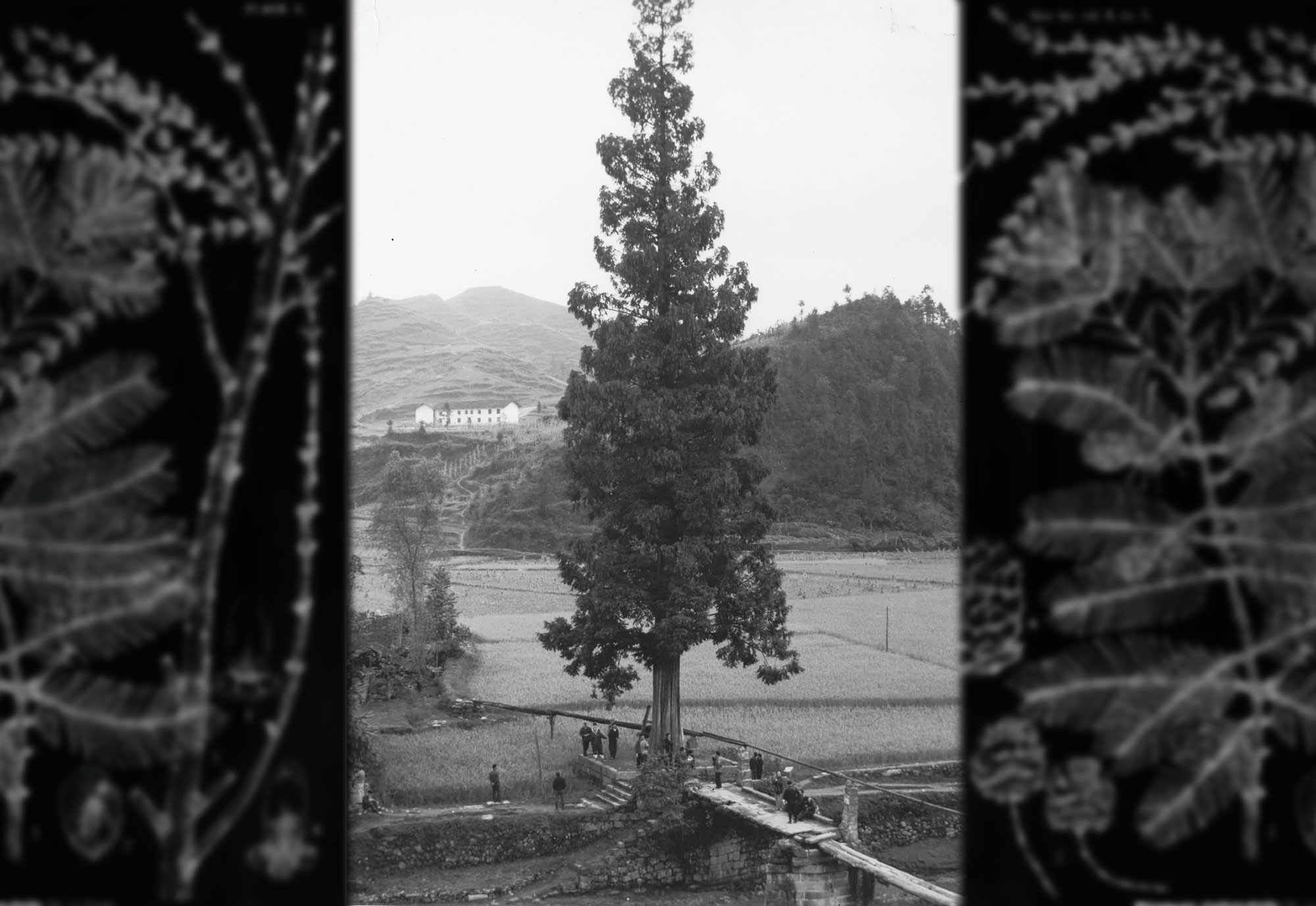
On December 2, 2025, the Arnold Arboretum hosted a virtual symposium celebrating the life and legacy of Hu Xiansu (Hu Hsen-Hu), who earned his doctorate from Harvard University in 1925. The centennial of his achievement offered the opportunity for reflection on the longstanding institutional, scientific, and cultural collaborations between Harvard and China paved by Hu throughout his career. Arnold Arboretum director William (Ned) Friedman was joined by colleagues Ma Jinshuang, chief scientist at the China National Botanical Garden (North Garden); Hu Xiaojiang (granddaughter of Hu), professor of sociology at Beijing Normal University; Mark C. Elliott, vice provost for international affairs and Mark Schwartz Professor of Chinese and Inner Asian History at Harvard University; and William C. Kirby, Spangler Family Professor of Business Administration, T. M. Chang Professor of China Studies, and chairman of the Harvard China Fund. Michael S. Dosmann, Keeper of the Living Collections at the Arnold Arboretum, and Lisa Pearson, Head of the Library and Archives at the Arnold Arboretum, both took part in the symposium as well, and this article draws from Pearson’s remarks. —Editors
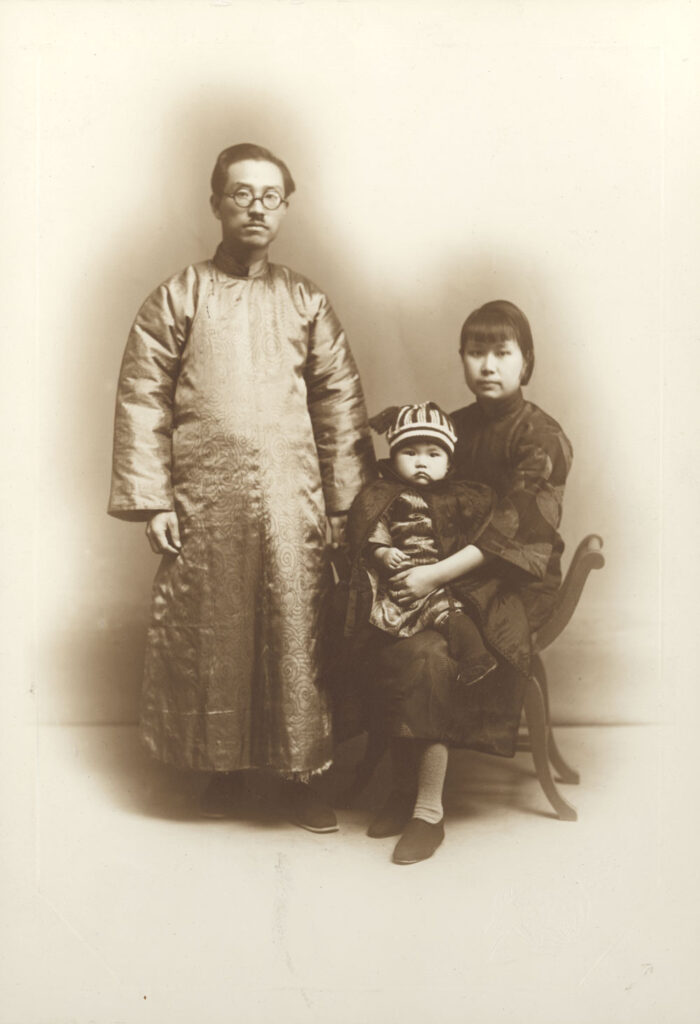
Hu Hsen-Hsu (Hu Xiansu), with his wife, Rongfen
Wang, and child, 1920s, Hu Xiansu quan ji = H.H Hu: Complete Works.
Many readers of Arnoldia are familiar with the magnificent Dawn Redwood, Metasequoia glyptostroboides, Shui Shan, and the part played by Hu Xiansu, (H. H. Hu) in bringing it to the world. Thanks to Dr. Ma Jinshuang, whose work publishing Hu’s writings and correspondence is invaluable, we can also tell the inspiring story of collaboration among the scientists who collaborated in its rediscovery and horticultural dissemination.
Ancient metasequoia grew over the northern hemisphere during the Late Cretaceous Period, about a hundred million years ago, down through the Miocene Epoch, five million years ago, then it vanished from the fossil record. This we know from its fossils, which were published as a new genus, Metasequoia, by Japanese paleobotanist Miki Shigeru in 1941. We know that Hu Xiansu had Miki’s paper, as well as a 1928 paper by S. Endo entitled “A New Palaeogene Species of Sequoia,” in which Endo described a new fossil species, Sequoia chinensis. Endo wrote further on Sequoia chinensis in 1933. In comparing the descriptions and plates in the articles, Hu noted the striking similarities of the specimens described in all three papers, and in a 1946 article he proposed changing the name Sequoia chinensis to Metasequoia chinensis for the ancient trees.
Chinese forest scientists conducted extensive fieldwork during the 1930s and ’40s. They collected specimens throughout the country to identify indigenous species, and used them to create national forest surveys, as well as to identify resources for the war effort. In the early 1940s, foresters observed what they thought might be a new species in an area on the Sichuan-Hubei border near Wanxian. It took several years to get samples, and for those specimens to be presented to Professor Zheng Wanjun. His curiosity was piqued, to him the sample was clearly not Glyptostrobus (a conifer found in southern China), but he needed more plant material to be sure. He dispatched a colleague to gather more material and then sent the samples to Hu Xiansu at the Fan Memorial Institute of Botany in Beijing for identification. Hu’s detailed knowledge of Metasequoia from the fossil record was no doubt critical in “connecting the dots” to link the ancient trees with the specimens which had been recently collected. In 1948, Hu and Zheng published their article describing the new tree in the Bulletin of the Fan Memorial Institute of Biology.
Stepping back two years to the spring of 1946, Hu had written to Elmer Drew Merrill, then Director of the Arnold Arboretum, to tell him about the newly recognized tree. Merrill and Hu’s relationship dated back to the early 1920s when Merrill, then with the United States Department of Agriculture in the Philippines, often verified or determined the identities of plants for his colleagues in China. Their collaboration grew over the decades, and after Merrill came to Harvard University in 1935, he wrote Hu about continuing exchanges of plant material and publications, a practice they had shared when Merrill was at the University of California and the New York Botanical Garden. In a letter soon after, Merrill told Hu that he had authorized a bank draft of $500, equivalent to nearly $12,000 today, to subsidize collections in Yunnan the next year. The subsidies continued until 1940, by which time the war had caused huge upheaval and made communication difficult; they would resume in 1946.
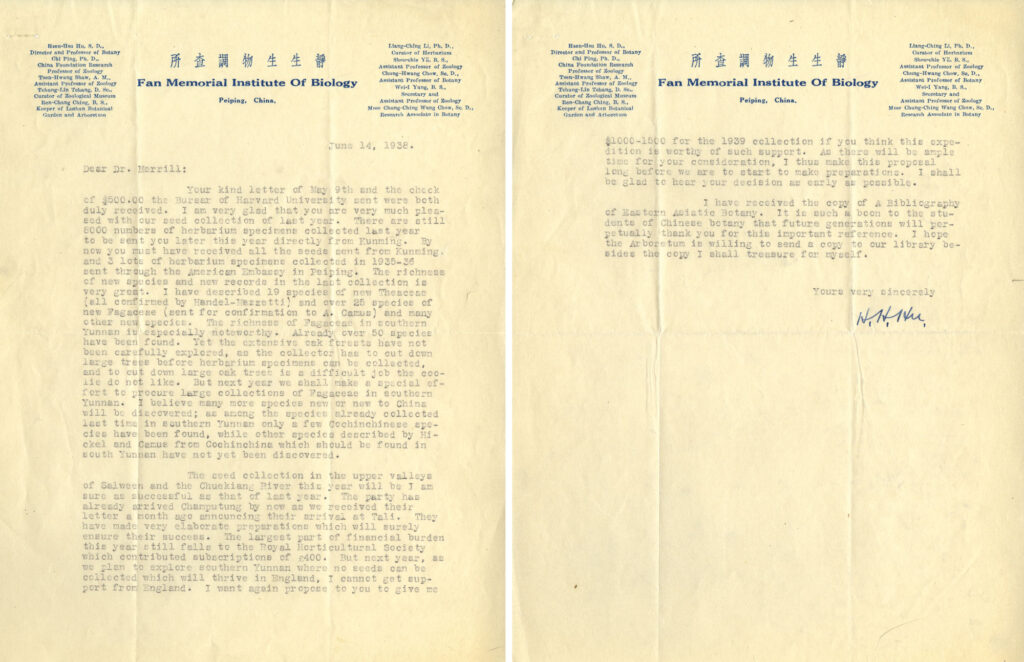
Letter sent from Hu to Merrill in June, 1938, detailing reception of funds.
Hu’s April 20, 1946 letter to Merrill discussed losses at the Fan Institute and the huge task of rebuilding the Lushan Botanical Garden (which Hu had also founded in 1934) after the destruction of the war. But it also contained this exciting news: “Have you received a communication from Dr. Wan-Chung Cheng announcing his discovery of a new genus of Cupressaceae,” Hu began, “which consists of a monotopic gigantic deciduous tree, found around Wanhsien in Szechuan? What a wonderful discovery it is! Only three lofty trees of thirty-four meters are living. Casually I also found a few small trees of Glyptostrobis pensilis in the back yards of a small village about forty miles from Nanchang. This proves conclusively that this conifer can easily be planted in the 6th zone in the States. When we have collected seeds from these trees, I shall send some to you. I hope this tree be more widely planted in the States.” Hu here is writing not about USDA Hardiness Zone 6, but its forerunner, the Arnold Arboretum’s hardiness zone system developed by Alfred Rehder. The Arnold was in Rehder’s Zone V; Hu hoped that the tree that would become our signature plant would prove hardy to our south. Metasequoia has shown itself to be hardier, however (and with climate change, the zones are on the move as well).
By late that year, Hu had seen a complete specimen of Metasequoia, which he describes in a December 2 letter to Merrill as “really a striking tree,” promising to send seed the following year to the Arnold for distribution. Merrill responded several weeks later saying, “That is good news regarding the Metasequoia. As I told you when you first announced the find we would eventually like to have specimens and, if possible, seeds also.”
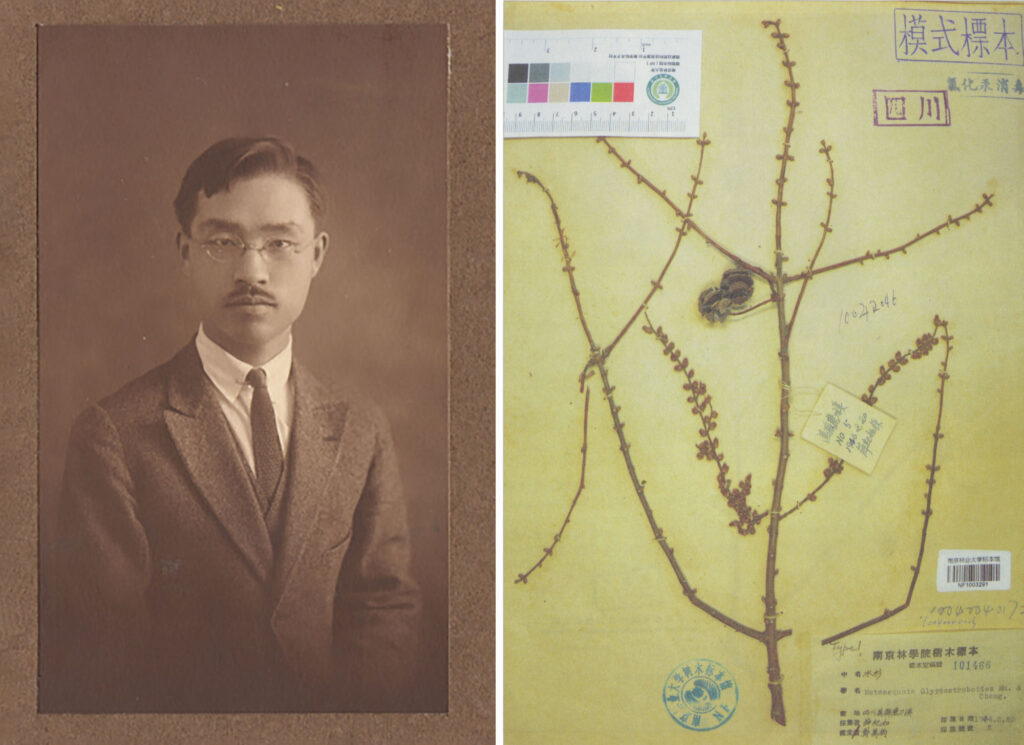
Left: Portrait taken by Harvard University of H.H. Hu in 1925 at 31 years old. Right: Herbarium type specimen sheet of Metasequoia glyptostroboides collected by Hu and Cheng in 1946. Both photos reproduced in Hu, H.H. 2023, Hu Xiansu quan ji = H.H Hu: Complete Works.
In Hu’s May 3, 1947, letter to Merrill, he enclosed his paper on the Paleogene species of Metasequoia, and asked for funding to collect seeds later that year. Merrill quickly responded, promising $500 for the dual purpose of collecting seeds and sending botanical material that had been stored during the war when shipping was impossible. In this letter, Merrill takes up the topic of the binomial, Metasequoia viva, which Zheng and Hu had been using for the living tree. In discussions with Arnold Arboretum taxonomist Rehder, both men felt that viva was too ambiguous and should not be used. Merrill also mentions that Zheng hoped to participate in the Metasequoia fieldwork and offered to send an additional $500 should Hu feel it was advisable.
Hu agreed, and told Merrill in a June 4th letter that he would use the money for the seed collection and also to send the stored specimens by air, the most reliable form of transport, to the American embassy in Nanjing for shipment to the US. He adds, “Concerning the name Metasequoia, Dr. Cheng at first proposed the specific name glyptostroboides, which seems very good to me.”
The funding soon arrived, paving the way for seed collections in the Metasequoia Valley. In his September 29th letter, Hu reports that seed production was lean that year, but that an additional stand of Metasequoia was found nearby. He says, “It will take another month for the fruits to ripen. When the seeds have been collected, I shall send them by air if possible.” A week later, Merrill responds, pleased to learn that “the expedition has been successful and that we might expect the seeds in the not distant future. If there be a sufficient number I shall distribute to Edinburgh, Kew and selected institutes on the West Coast including the Save the Redwoods League.”
In early January, 1948, Hu reports that “the expedition to collect seeds of Metasequoia has been successfully concluded . . . the seeds were collected by one of the graduate students of Professor Cheng from both the type tree and a tree of Li-Chuan Hsien of Hupeh province. Professor Cheng wrote that a large package of seed will be sent to you via a graduate student, and a small package will be sent to you via mail directly.” Later that month, Merrill writes, “I received the first shipment of Metasequoia seeds on January 5th, a larger lot expected through a graduate student enroute to the United States either late this month or in February.”
Hu sent more Metasequoia seed, collected in Lichuan, by airmail in mid-February with the instructions to distribute them to large nursery companies. He hoped to interest those companies in contributing to further fieldwork as only $250 of the $1000 sent by Merrill had been used for the field collections. By early March, 1948, the seeds had all been received and Arnold Arboretum staff had sprung into action preparing and sending packets to various institutions and nurseries. Metasequoia was on its way to the world!
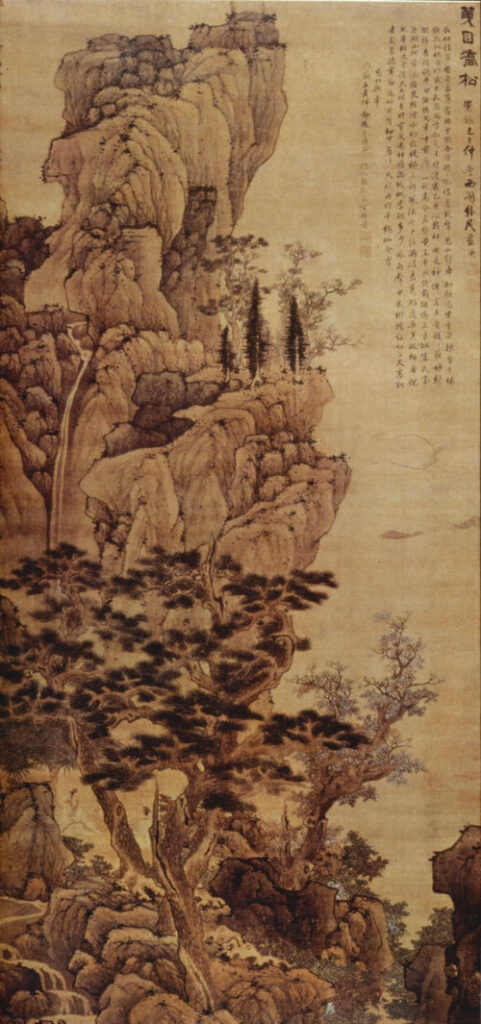
West Tianmu
By Hu Xiansu
Between Guo and Wu, the perfection of this realm—
Both Tianmu peaks lifting east and west.
How can mountains rise so high?
A sea of clouds, ten thousand peaks
Range in ranks along the sky.
All night a pine wind weeps,
The long swell of autumn in the dark.
The stream encircling, the valley holding close the orchids
Where vines entwine and creepers tangle
And sway with gibbons in the trees.
When I go to the Dragon Pool to rinse my two eyes
I see the down of autumn in my hair.
“西天目.” Hu Xiansu. 2022. Hu Xiansu quan ji = H. H. Hu: Complete Works. 第1版. Nanchang: Jiangxi ren min chu ban she. Hu was born into perhaps the last generation to be schooled in the literati way, and for anyone so trained, writing poetry in classical style was a must. This poem depicts a landscape that figured prominently in his scientific work, and in the collections of the Arboretum, too. Thanks to Victoria Lin for help in translation.
Merrill retired from the directorship of the Arnold in 1946 and became Professor Emeritus in 1948. He was no longer in a management position at Harvard University, and his ability to aid Hu ceased. Through 1948, his correspondence with Hu waned as he began his retirement. Reorganizations in China due to the Communist Revolution in 1949 further disrupted their communication, and sadly, a twenty-five-year correspondence ceased.
Hu and Merrill’s decades-long support of each other’s academic missions was exemplary. Both men worked collegially to advance their personal scholarship and institutional goals, despite laboring a world away from each other, in an age when communications were not instantaneous as they are today. We should all take a lesson from their dedication and perseverance in the collaborative pursuit of botanical knowledge.