Start with the leaves, the small twigs, and the nests that have been shaken,
ripped, or broken off by the fall; these must be gathered and attached once
again to their respective places.—W. S. Merwin, “Unchopping a Tree”
It seems true to say that, for many poets, at some point it becomes necessary that they should take up horticulture. They might seek a brighter garden where not a frost has been, or find fair quiet there, and innocence, her sister dear, or pluck chrysanthemums at the eastern hedge and gaze long at distant summer hills. From the start, W. S. Merwin’s work wove in and out of gardens and landscapes from Pennsylvania backyards to the fields of Provence. And then he settled on Maui and cultivated a garden of palms in a landscape that had been scourged by the extractive agriculture that accompanied—no, that was—the Americanization of the Hawai‘ian archipelago.
W. S. Merwin (1927–2019) won the National Book Award, two Pulitzers, Yale’s Bollingen Prize for Poetry, and the PEN Translation Award, as well as being named Poetry Consultant (1999) and Poet Laureate (2010) by the Library of Congress. Such laurels carry little currency in the broader culture, however; well-read, non-literary friends rarely recognize Merwin’s name or lines, and it’s rare even for my literary friends to know his work well. Merwin had a grace about this marginality, seeking margins where he could be in fruitful relation to the world and his work. It feels as though where Merwin chose to write—and as much, where and what he chose to cultivate—matters.
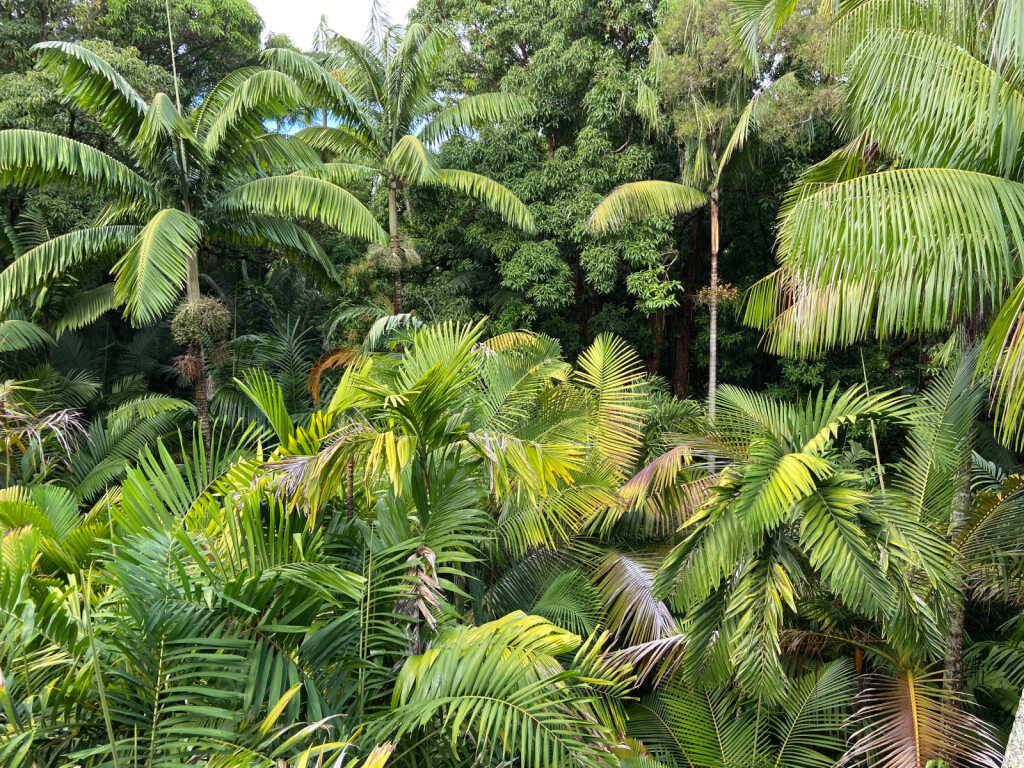
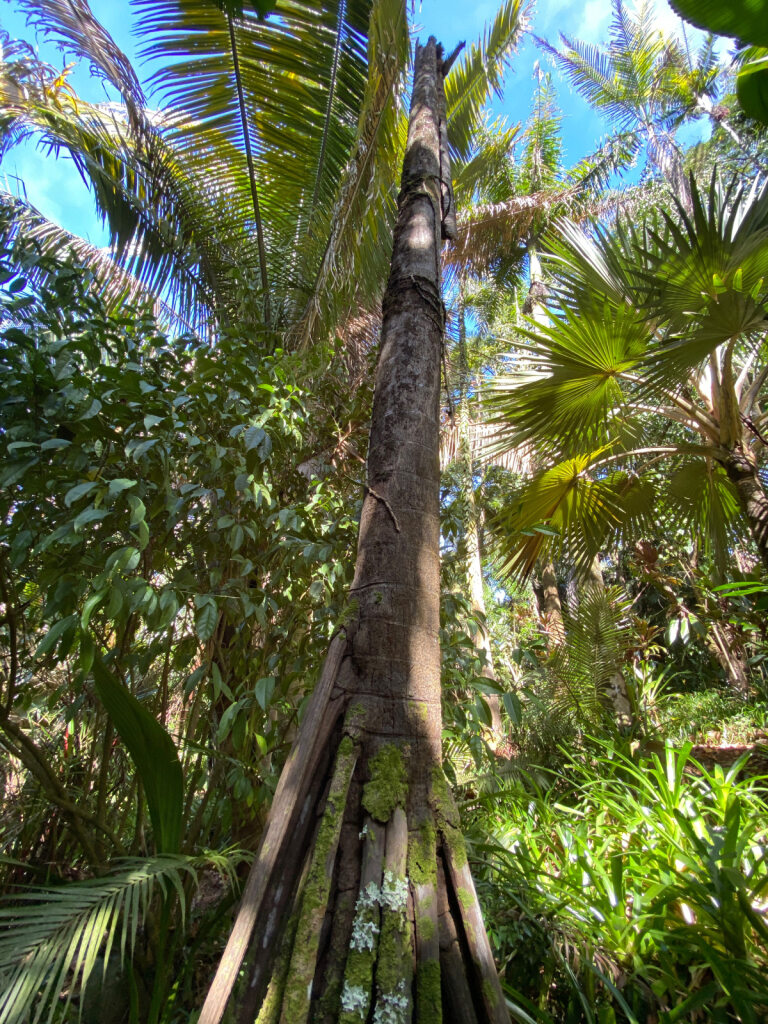
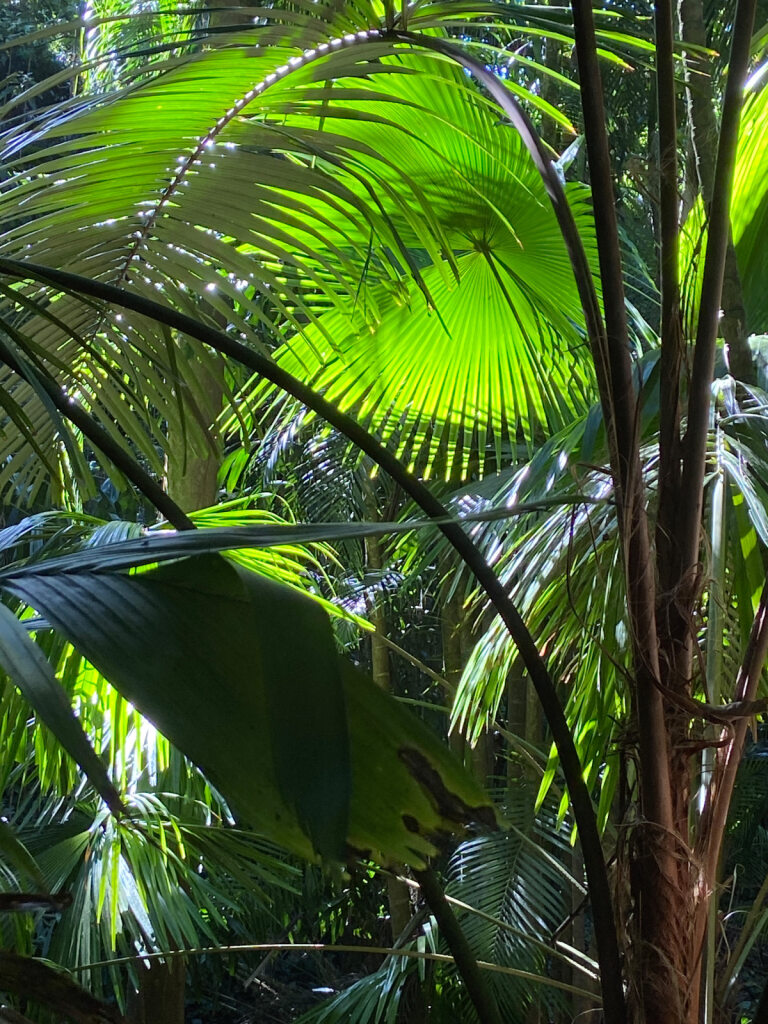
If you don’t know Merwin’s work, how can I help you understand what the prospect of his garden holds? What’s the promise of a landscape tended by this poet, by dint of this imagination, this reckoning with the flickering powers of language and cultivation? A view of his palm trees will get you at least partway there: standing on the porch, looking out into a frondful world, across a steep sweep of lively foliage
that rakes and sighs in the breeze, fronds and fruit streaked and glossy, brimming into the sky, while birdcalls ring out like temple bells through the soft doors of the rain.
Poetry; gardening—they analogize each other. In perhaps his most famous poem, Seamus Heaney recalls his father and grandfather in the garden, their strain and stooping; of “the coarse boot nestled on the lug” of the spade, its bright edge buried deep to open the earth. And yet, although “(t)he curt cuts of an edge/Through living roots awaken in my head,” the poet has “no spade to follow men like them.” And then, remembering the “squat pen” resting in his grip: “I’ll dig with it.”
In Merwin’s case, arboreal commitments go farther than mere analogy. Beyond the tree-specific imagery that haunts his poems, which have the stillness and suppleness and restful longevity of trees, and an intimacy, much as his palms crowd into one another with the kind of intimacy only trees can know. Merwin’s cultivation of palms is an “unchopping” of the kind he describes in his deceptively lighthearted poem, “Unchopping a Tree,” where he imagines arboreal reincarnation as a methodical practice, a re-forestry: summoning of ghost limbs, beckoning broken roots to grasp again the ragged soil, applying stitchery to blades of leaf, gathering them into fans and whorls, inviting them once more to stretch, creak, and reach out to one another. We must seek this poet in his potting and tending, cutting and planting, whose logic of the seed reattaches wood to world. And perhaps along the way, we discover that the garden has been unchopping the poet as well, reassembling something long lost in him, whose presence could not be felt unless it got in under the fingernails, unless it seamed his hands with stain of soil.
He began his journey with coconut palms—”so ignorant,” he writes, “that I scarcely knew other palms existed.”
Somehow I found myself muddied in these matterings. When I was a young writer trying my hand at translation, Merwin’s poem “Learning a Dead Language” offered not only a method but a metaphysics, an experience of living and language enlivened by “what passion may be heard/When there is nothing for you to say.” As the losses of adulthood accrued, there came the solace of “Rain Light,” with its flowers that are “forms of water” blooming under a sun that “touches the patchwork spread on the hill/the washed colors of the afterlife/that lived there long before you were born.” And so, after much pondering and planning, when I had the chance to visit his Maui garden, it felt like a kind of pilgrimage.
Tucked away along a winding farm road leading toward the roar of Maui’s legendary surf breaks, the place is hard to find. I got as far as the Jaws General Store on Maui’s Hana Highway, where I met up with Sonnet Coggins, the Merwin Conservancy’s extraordinary director, who drove me down into the shady redoubt where the house shelters amid the palms. Coggins, a longtime museum leader whose family story is woven into the history of Hawai‘ian cultural and political resilience, then led me on a tour of the palms, shouldering a great satchel full of Merwin’s books, opening them here and there to read lines with affection and generosity.
We visited the potting bench, where seedlings spring from pots like spry emoji, belying the gravity into which they will grow; we peered into Merwin’s zendo, a simple screened shelter looking out into the garden, where I later sat zazen in the rain.
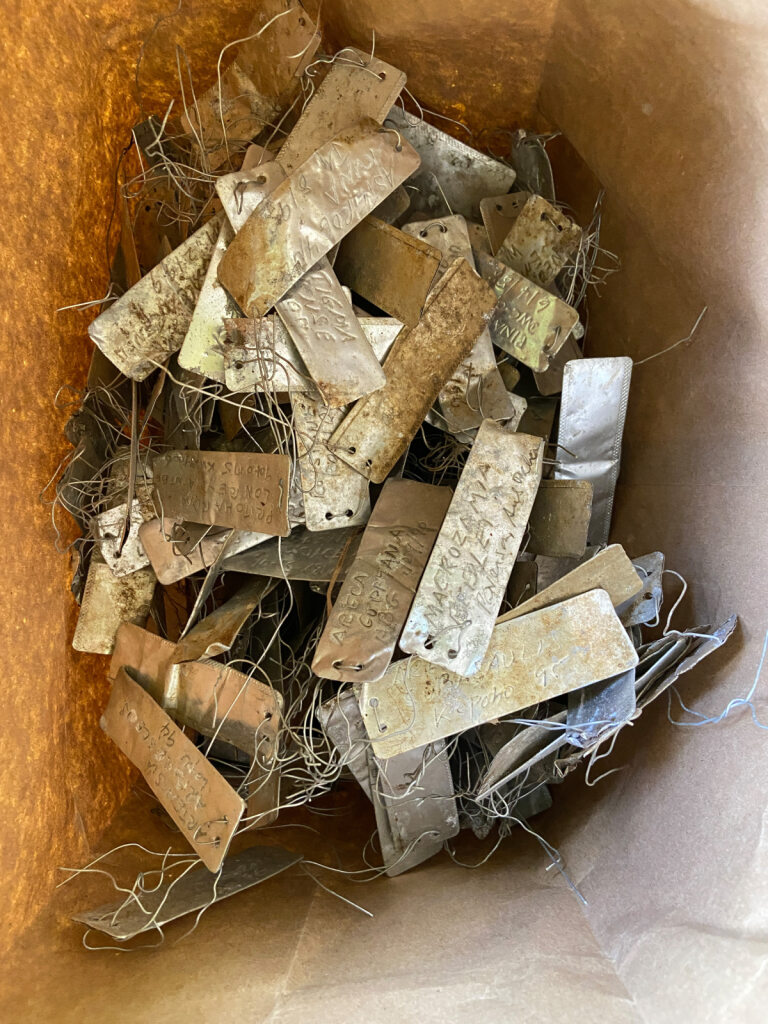
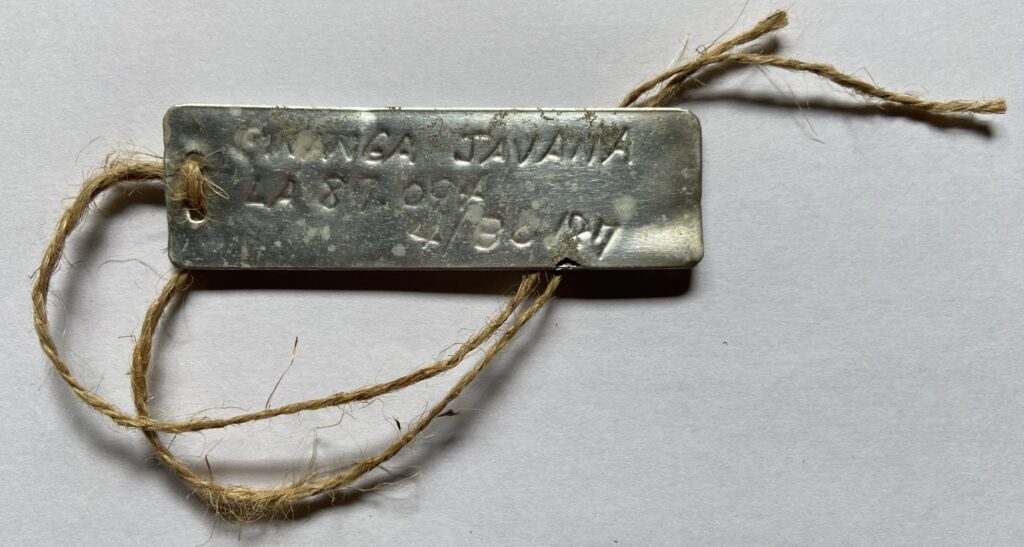
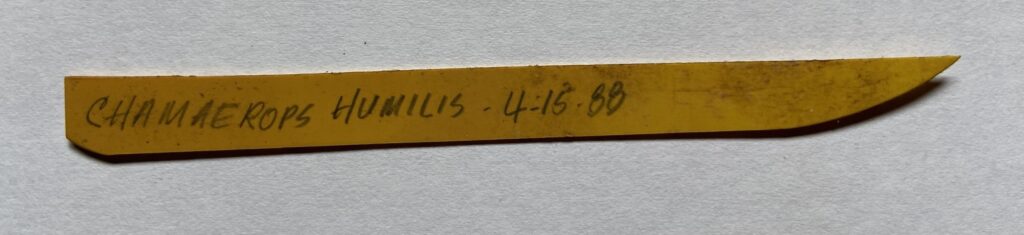
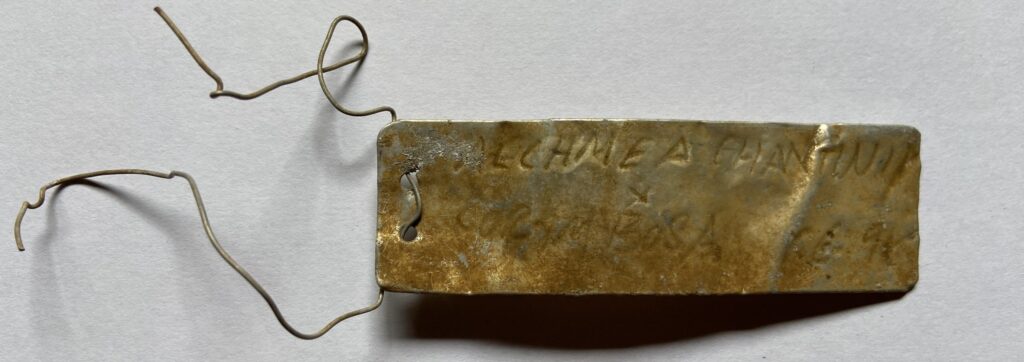
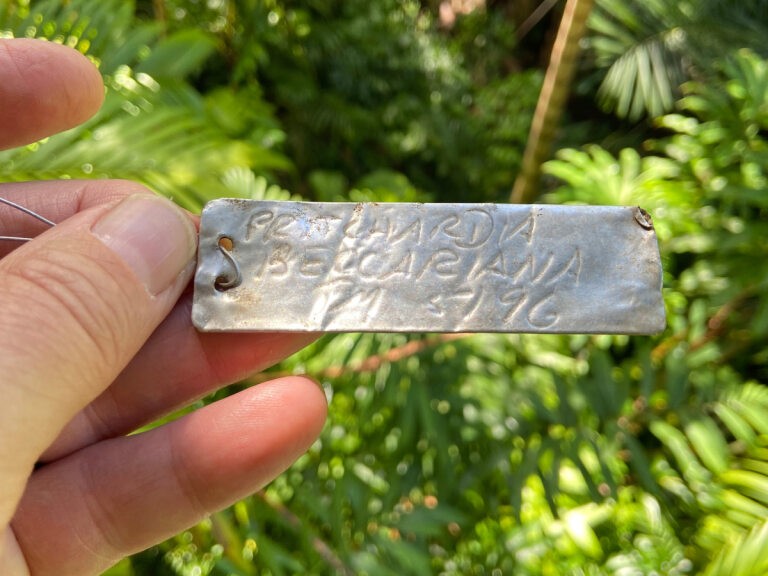
Eventually, Sonnet led me into the house and left me with boxes of typed letters in original and carbon copy arrayed on the dining table. Before setting to work on these, however, I spent a long time piecing through the tags Merwin made for his trees—standard-issue horticultural tags of aluminum, resin, and zinc, purchasable by the bundle at garden centers or online, upon which Merwin scratched the scientific
names of the trees he planted. In time he planted more than 3000 palms from around the world, cultivating them with care and curiosity; and the culture of palms flourishes there today, some seven years after his death.
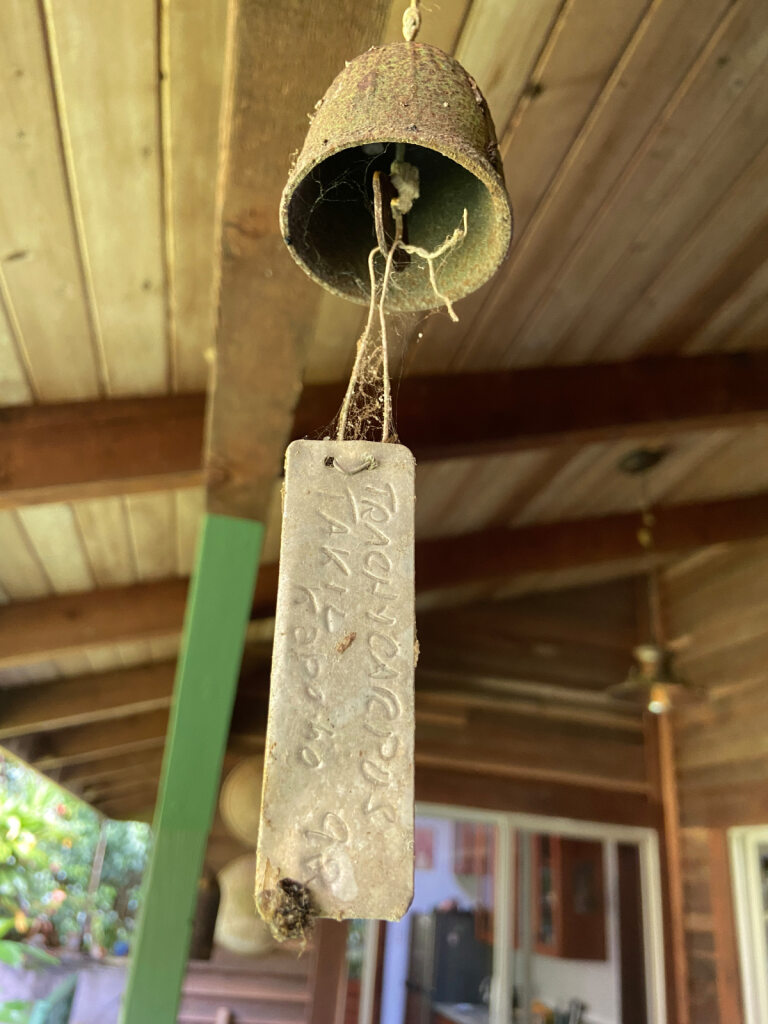
Tangled together in paper sacks, dust-settled on benches, or used in sly decoration here and there throughout the house, the tags bewitched me. The names emblazoned on them rattle with a fossil poetry. Like botanical taxonomy, Merwin’s poems were nourished by many languages, and the fragments and echoes of the nomenclature chime with the passions of the dead, their sense of what is memorable in encounters with the living world.
Merwin first traveled to Hawai‘i in the 1970s to study with Robert Aitken, a Zen teacher with a literary bent. For many years, he had long lived the globetrotting
academic poet, alternating long stays in rural France with stints in Majorca, London, New York, and Boston; Maui would become his home for the rest of his life. What did he find there? “Clover does not think about responsibility,” Aitken wrote in a book called Mind of Clover, “and neither did Shakyamuni (a name for the Buddha). He simply arose from his seat and went looking for his friends.” Perhaps it was in search
of friends—if light and landscape and trees may be counted as friends— that Merwin came to Maui. He bought the land for his garden in 1977, a used-up pineapple farm in the Pe‘ahi Valley on Maui’s north shore. A few years later, an adjoining parcel became available, and through the interest and generosity of the seller and friends, Merwin and his wife, Paula, were able to add this property to the garden. Tremendous work remained to transform the landscape from its desolate condition into a living forest. At the time, the land there was barren and grassy, with long corrugations in the soil running steeply to seaward, indicating that the pineapple growers had plowed the fields downslope, which had allowed a great deal of topsoil to run off with the rains.
Long before the pineapple growers and cattle had come and gone, however, The Merwins’ parcels were counted part of Pe‘ahi, an ahupua‘a or traditional district—typically a sector of land running from volcanic slopes down to the sea, encompassing streams, forested uplands, and cultivated ground. As ethnographers Kepā and Onaona Maly point out in the ethnohistorical study they prepared for William and Paula’s trust in 2021, the word pe‘ahi, which also names a fragrant local fern (Microsorum spectrum, known elsewhere in Hawai‘i as laua‘e) is “often associated with the light winds which blow from the ocean and across the land causing leaves of the niu (coconut palms) to nod or flutter as if waving.” The word, like the place, thrums with the energy of dancing leaves.
Merwin had hoped to replant this landscape with native forest species. The complexity of such ecological restoration is daunting throughout the islands, however, and the koa trees he tried to reintroduce would not thrive. The soil “had been leached out,” he writes in What Is a Garden?, a volume of photographs,
essay, and verse celebrating his work with palms, and the land proved “unwelcoming to what had once grown there.” He found his way to a successional approach instead, beginning with introduced casuarina trees, choosing varieties not prone to invasive growth. “Even in the conditions here they began to grow rapidly,” he continues, “and within a few years they began to form a miniclimate as they shaded the ground, added humus with their fallen needles, held the water after heavy rains, and put nitrogen back into the soil.” Eventually, termites took apart the casuarinas, further feeding the soil and laying the groundwork for palms to flourish toward forest.
He began his journey with coconut palms—“so ignorant then, he writes, “that I scarcely knew other kinds of palms existed.” He marveled to learn of “a whole lore of coconuts” tracing their origins “from the heads of children who died of hunger,” or “the heads of fishermen who had dangled their hair in the sea as bait, and of some that sprang from the heads of gods,” suggesting that “(f)rom the moment they began to grow, they would be native to the spot, in one sense at least, as I could never be.”
By the mid 1980s, Merwin was committed fully to the culture of palms—not only to their planting and propagation, but to correspondence with a far-flung network of fellow palm fanciers, horticulturists, and palm specialists. “It’s clear that we have come home to Christmas,” Merwin writes in a letter to one of his chief palm correspondents, Inge Hoffman, dated June 18, 1987, “whatever the calendar may say.” Hoffman ran the International Palm Society, which she describes in her letters to Merwin as a shoestring affair held together by her and her husband. Inge comes across as gritty and irascible in the face of money woes, the competitive throes of palm culture and constant oversight from the USDA. She and Merwin had an affectionate correspondence, full of bluster and brio, and when Merwin returns from a long mainland tour, the presence of a shipment of many seeds from Inge is magnificent to him. “The joys of being among our overgrown trees and garden, instead of in a city, were quite heady enough, but then, among the mountains of mail, these white muslin (seed) bags with the attached cards, that always make the heart (this one) leap up.” Abashed, he suggests that he might not have the skill to germinate them and bring them all to maturity. “But the number of seedlings, the variety, grows, and the number of young trees in the ground, and thriving, grows, and our hopes with them.”
Reaching out to gardeners throughout the tropics in search of new seeds, he maintained his amateur poise. “I should tell you at once that I am not a professional botanist and still less a commercial nurseryman,” he offers Maria Horton of Loja, Ecuador, in a letter dated January 18, 1989. “I am a writer by profession, and my love of the natural world, the tropics, forests, and gardens and palms is that of a rather ignorant amateur, learning as he goes. But the seriousness of my love of these things is quite plain in my writing.”
But he also was keen to avoid public entanglement, to preserve his energies for his poetry. When asked to serve on a “Conservation Committee,” Merwin drew a line: “I am certainly deeply sympathetic with its goals,” he wrote in a letter dated July 14, 1989. “But after a couple of weeks pondering it, I am certain that I must respectfully ask to be excused from that honorable post. I am not in any respect an administrator and have neither the experience, the gift, nor any of the other qualities needed for committee work, I fear.” Instead, he offers the enterprise of the poet and the artist to cultivate and conserve through inspiration: “I will have to content myself, and you too, I trust, in trying to do some things for the same goals, in private, as I have always done— and as writers, artists, poets, you know, are always more likely to do.”
There is a way Merwin’s correspondence about the garden emerges like gardening, unfurls like seedlings into leaf and limb. A mid-twentieth century writer near the turn of the millennium, working amid the advent of the personal computer, Merwin’s practice still followed the prior rhythms of manuscript, correction, typescript. This isn’t unusual or distinctive for a writer of his time, of course. But it’s worth recalling the patience, the repetition, the slow cultivation: the first draft in longhand, hoeing the earth, finding the lines, turning the soil; next, the editing, like thinning and weeding; finally, the typescript, which is perhaps a harvest, or a long, slow tour down the rows to survey the fruits of this labor. Or not yet the fruits—those come with the sending, the receipt, the reply. And to keep a copy is to save seeds, so that this foison may be sown elsewhere another time. Both trees and typescript pages sequester carbon.
A letter to Scott Lucas, curator of living collections at the National Tropical Botanic Garden on Kauai in the 1980s and ‘90s, offers the suggestion that Merwin occasionally would share poetry with his palm correspondents. “I am often hesitant about sending such things to people if I don’t know them well,” he confesses to Lucas—and he offers an aching assessment of the limit of poetry’s reach: “Not everyone reads such literature in our society, and some are embarrassed to have to respond. But your response, and then the manner in which you conveyed the
other treasures give me the image of someone careful, thoughtful, inventive and so on—I trust you know the rest yourself, though it’s not safe to assume either that people really know themselves.”
It’s tantalizing to imagine how this exchange unfolded in full. Had he sent a book, or chosen some especially relevant verses to enclose with a packet of seed? Did he inadvertently write up his recipe for diatomaceous earth on the back of a galley proof or carbon copy of typescript essay or verse, as he does with many of these letters? What verses might they have been? I like to think it might have been a slip of draft from The Folding Cliffs, Merwin’s epic telling of the story of Pi‘ilani Kaluaiko‘olau and her family, who lived on Kaua‘i at the end of the nineteenth century. Though her family’s tale is framed as epic here, their suffering was very real: When her son Kaleimanu contracted leprosy, they fled with the boy’s father Ko‘olau, disappearing into the Kalalau Valley backcountry. They feared that Kaleimanu would be sent to the concentration camp for leprosy victims on Moloka‘i, set up by the Provisional Government created by US-born settlers and businessmen after the overthrow of Queen Lili‘uokalani in 1893. Long before Merwin turned his attention to it, their story
was a great epic of Hawai‘ian cultural survival—best told by Pi‘ilani herself, who wrote it in Hawai‘ian for a book published in 1906, after her son and husband had died and she came out of hiding.
Pi‘ilani’s own telling is terse and urgent; Merwin lingers over the imagined interfusion of primeval Hawai‘ian life, evoking the life he wished to kindle in his garden, of “voices never heard before singing out of/ a source in the yolk of their unmeasured morning”; of the “undisturbed” trees that keep “beginning and beginning.”
The first shadow was beginning to surface in the darkness
through a net of trees when she came to the swollen stream
of Halemanu the house of birds where in earlier dawns
the birds had the forest to themselves waking there
into plumage and colors never seen anywhere
crests and feathers heads and motions never before
entered upon voices never heard before singing out of
a source in the yolk of their unmeasured morning
inexhaustibly beginning and beginning
as the undisturbed trees and flowers kept beginning around them
—from The Folding Cliffs
I think of Merwin’s words to Scott Lucas: It’s not safe to assume that people really know themselves. Some critics denounced The Folding Cliffs as an act of cultural appropriation. And there is real danger here, that the word-weaving of an eminent haole poet might eclipse a story Pi‘ilani already had told in her own words. In the same way, there was a forest on Merwin’s land before he made a garden for palms
there. And then, people came from over the ocean, and the relations with the land were sundered or challenged by change: by the cattle they brought, by the pineapple their mainland confreres craved. Living relations in the land, relations of native plants and Polynesian introductions, once interwoven in lively equillibrium, were frayed, then unwoven altogether—the land denuded of vegetation, of soil, of life, stripped to the substrate, the living matrix washed down to the sea, gnawed upon by rolling Pacific. What Merwin created here was a garden, which is to say a kind of poem—a new speaking of the place. He realized very quickly that recreating a native forest here would not be possible. And what would it have meant to try, anyway? For in the end, even the most hopeful poet knows that there is no unchopping that will reknit the trees, restore the land, resurrect all its relations. So he brought palms from around the world together, here, into a new kind of relation. It’s a palm garden for our time, for islands in the Anthropocene, islands which can never truly be islands again.
Can The Folding Cliffs be understood in the same way? Can we read Merwin’s account of Pi‘ilani, Ko‘olau, and Kaleimanu as a tale told alongside, and not instead of, the original? I think of the Vietnamese documentary filmmaker Trinh Minh-ha, who describes her work as “speaking nearby instead of speaking about” her subjects—“a speaking that does not objectify…. A speaking that reflects on itself and can come very close to a subject without, however, seizing or claiming it.” I fear that The Folding Cliffs, for all its flow and formal grandeur, does not take this stance; for my part, I feel it standing between me and Pi’ilani. In the garden, by contrast, Merwin did achieve this effect of standing nearby. Propagating, planting, and tending his palms, Merwin was gardening nearby the Hawai‘ian living world, not in tension or opposition or contrast, but in tribute, in solace, in care.
I think of “Rain Light,” perhaps Merwin’s greatest poem, published in 2008. In it there
is an oblique intimacy, at once murmuringly nearby and vast, porous:
All day the stars watch from long ago
my mother said I am going now
when you are alone you will be all right
whether or not you know you will know
We’re in a place that could be anywhere, a time that could be any time, but also deeply here and now, close as heartbeat and immediate as breath, wherein the person, too, is a place. A place nearby, wherever we are. There is such spaciousness in this verse, such openness, the vast vertical span of the stars watching—watching whom or what? Are we visible to them? Visible as we are to trees, I suspect . And the mother’s speech bubbling up like a murmur, like a thing overheard, without explanation. when you are alone…/ whether or not you know…. The plenitude and possibility are the point.
Merwin’s style, which long had been spare, begins to reach toward a lucid austerity. His lines shake loose from punctuation, capitals are mostly banished. Not unlike Dickinson, Merwin invites us to slow down, to rest in the emptiness and liquid syntax of his lines, to let their grammar blossom for us in its own time. There is an invitation to tranquility, but also to rigor, the rigor of attention, to precision and seriousness. And in “Questions to Tourists Stopped by a Pineapple Field,” first published in 1983, there is the gleam of this rigor, even a severity:
did you like your piece of pineapple      would you like a napkin
who gave you the pineapple      what do you know about them
…
what do you think was here      before the pineapple fields
would you suppose that the fields    represent an improvement
The poem is long, a litany of unpunctuated questions, dripping and astringent, the poet exposing the tourist to a dose of their own relentless interrogations, ringing the changes from pineapple rings to land plowed and scarred to the casual pondering of investment possibilities. when you look at things in rows | how do you feel, asks this poem of rows and feels. Each line is broken by a pause, a long space called a “caesura.” Such breaks often have metric and rhythmic purpose. Here, the caesurae feel more than merely structural; with each pause, there is a weight, a discipline, patient and severe. They begin to feel to me a bit like swings of the kyosaku, sometimes known as “the encouragement stick,” traditionally wielded by Zen Buddhist teachers to cultivate attention in the meditation hall.
I read the poem “Questions to Tourists Stopped by a Pineapple Field” and think of a fruit stand where we once stopped on O‘ahu’s North Shore: mounds of pineapple and mango sheltering under a canopy in a park looking out across Kaneohe Bay, the weathered pyramid of Mokoli‘i rising green and quiet away across the waters. The vendor chatted away with a friend in Hawai‘ian as she sliced our fruit, piling slices of mango and pineapple and great rough-edged potsherds of coconut meat. And when the fruit-seller’s friend heard we were from Boston, she sat with us while we ate our fruit and told us about her granddaughter, a student at Brown University, and the juices ran into sticky streaks down our hands and wrists, and we talked about the bigness and smallness of the world.
Merwin was a prolific translator, and often mentioned to interviewers that he turned to translation as a young writer, when he found he didn’t yet have much to write about (following a dictum handed down by Ezra Pound, he often said). It strikes me that gardening also is an act of translation, trying to intensify, interpret, and carry over plant meaning in ways that matter to humans. I want to say that gardening, and in particular working with a garden that hopes one day to be a forest, played a role in Merwin’s late art much like the catalytic effect of translation on his early poetry. Merwin’s late lyric has a vegetal quality: shorn of punctuation and mostly undivided into stanzas, the lines seem at once unruly and reposeful, sprung forth without animal starts and stops. There’s something twitchy about punctuation, I’ve begun to feel—twitchy and grasping, the way it bends the reader into stops and pauses, bursts of exclamatory or interrogative busyness (it’s worth noting that in the Hawai‘ian language, the okina, which looks to a reader of western languages like an apostrophe, is not a punctuation mark, but a letter of the alphabet). Merwin’s lines root, twine, hold fast; the reader must sit with them awhile in patient regard before their activity makes itself apparent. The way the promise of the flower steals forth for a gardener, the bloom and ripening of possibility.
Before the coming of modernity, the ahupua‘a of Maui’s north shore supported a water-intensive horticultural lifeway of great ecological and social sophistication. The people planted along the streams, carved terraces into the slopes of the ravines running down from the flanks of Haleakala to the ocean, fringed them with bananas, and flooded them for taro. In What is a Garden?, Merwin calls the landscape of the north shore “a testament of water,” its flowing force “the origin and guide of its contours and gradients and of all the lives—the plants and small creatures and the culture—that evolved here.” Rain comes to this coast with the trade winds; and “in the poetry of the Hawai‘ians,” Merwin notes, “rain almost always is the rain of a particular place, with a specific character and an allusion to an erotic element of some story draped with names…. The sound and touch and smell of the rain, the manner of its arrival, its temper and its passage are like a sensuous visit to the garden, and the light among the trees after rain, with its own depth and moment, iridescent, shifting and unseizable, is an intensified image of the garden at that instant.”
Or to say it in verse, from “Rain at Night”:
but the trees have risen one more time
and the night wind makes them sound
like the sea that is yet unknown
the black clouds race over the moon
the rain is falling on the last place
Elsewhere in What Is a Garden?, Merwin reflects on how modernity has changed the role of gardens, which “from the beginning … existed as enclaves designed and maintained to keep out the wilderness, to guard what was inside for human use or pleasure.” Now that it is possible for “human beings to destroy environments anywhere on earth, the situation (has) turned around, and anyone who want(s) to protect and save any remaining bits of the natural environment (is) acting in the role of a gardener…. to keep encroaching human exploitation and disturbance out. The model for this garden has always been the forest itself, even though I know that the word ‘reforestation’ is generally meaningless, and that only a forest knows how to grow a forest.”
Only a forest knows how to grow a forest. Merwin’s late vision offers a loosening of the hand closed on pen and trowel—a recognition that this writing, this garden, this forest, ultimately makes itself. For even as the garden takes shape as a made thing, “it is only the humans in it who think of it as a garden,” he notes in What is a Garden. “But a garden is a relation, which is one of the countless reasons why it is never finished.” And this relationality draws not only plant and plant, but plant and poet, poet and poem, into intimacy. “The practice and art of gardening are remarkable pure forms of the element of paradox underlying all human art and language,” he notes. “A plant in a garden is at once the natural world itself and an object of human arrangement. In a garden we draw something of nonhuman life into our history.”
Would I love it this way if it could last?
—Merwin, “Morning” (from Garden Time, 2016)
Under Coggins’ creative leadership, the Merwin Conservancy has become a marvel. Merwin’s rough zinc tags have been replaced and supplemented by a collections database catalogued by John Dransfield, former head of palm research at Royal Botanic Gardens, Kew. The garden also hosts a residency program giving artists and writers the nourishment of the place. And the arboriculture is strong, too—with the support of the Garden Club of Honolulu and guidance from scientists at the National Tropical Botanic Garden, they’re breeding loulu (Pritchardia glabrata) palms, which are native to western Maui, in hopes of offering them as part of revitalizing Lahaina in the wake of the devastating 2023 wildfire.
“A garden is made of hope,” Merwin writes in What is a Garden? “It cannot be proven, nor clutched, nor hurried. And the hope of a palm garden is to be a palm forest.” Coggins tells me that she and the community that supports the Conservancy are not merely seeking to preserve, but looking for the ways its tenancy might speak to the heritage and future of Hawai‘i, the palms, and the living world. A speaking nearby; a speaking here.
At the end of my day at Merwin’s house, I was putting on my shoes on the front porch, waiting for Zirque Bonner, the Conservancy’s caretaker at the time, who would give me a ride back up to the Hana Highway and Jaws Country Store. He was locking the front door, its suave brass fox doorknocker rattling resonantly as the door heaved to. A small stone fountain burbled by the side of the porch; in the garden, which is also a forest, a bird was calling, ringing out with a sonorous, liquid thwick that ricocheted among the palms. I remarked how complex the beauty of the place was. “I tell people I get to work inside a poet’s imagination,” Bonner replied, his arms outspread in a gesture that took the home, the bird-and-fountain song, and the trees in its embrace.
ACKNOWLEDGMENTS: Many thanks to Merwin Conservancy director Sonnet Coggins and to Nina C. Peláez, associate director, for assistance in matters of fact, reference, and Hawai‘ian culture and orthography.
REFERENCES
- Opening paragraph: “a brighter garden, where not a frost has been”—from “There is Another Sky” by Emily Dickinson (1830–86), first published in Poems by Emily Dickinson, First Series (1890); “find fair quiet there, and innocence, her dear sister”—from “The Garden” by Andrew Marvell (1621–78), first published in Miscellaneous Poems, ed. Mary Marvell (1681); “pluck chrysanthemums at the eastern hedge and gaze long at distant summer hills”—from an untitled poem by Tao Qian (c. 365–427) in A Hundred and Seventy Chinese Poems. Arthur Waley, translator. New York: Alfred A. Knopf, 1919.
- Chen, Nancy. “A Conversation with Trinh Minh-ha. Visual Anthropology Review vol. 8 no. 1: Spring 1992.
- Heaney, Seamus. 1966. “Digging.” Death of a Naturalist. Farrar, Straus, & Giroux.
- Jarman, D., & Sooley, H. 1995. Derek Jarman’s Garden. Thames and Hudson.
- Kaluaiko‘olau, Pi‘ilani, and Frances N Frazier. 2001. The True Story of Kaluaikoolau. Lihue, Hawai‘i : Honolulu: Kaua‘i Historical Society ; Distributed by University of Hawai‘i Press.
- Kepā & Onaona Maly. 2021. He Wahi Mo‘olelo No Pe‘ahi A MeHāmākua Loa, Maui/A Resource Guide Through the History of Pe‘ahi and Hāmākua Loa on the Island of Maui. Kumu Pono Associates LLC.
- Merwin, W. S. 1998. The Folding Cliffs: a Narrative (1st ed.). Knopf : Distributed by Random House.
- Merwin, W. S., Wutz, M., & Crimmel, H. 2015. Conversations with W. S. Merwin. University Press of Mississippi.
- Merwin, W. S. and Cameron, L. (ed.) 2016. What Is a Garden? The University of South Carolina Press.
- Merwin, W. S. 2016. Garden Time. Copper Canyon Press.
- Merwin, W. S, and Michael Wiegers (ed.). 2017. The Essential W. S. Merwin. Port Townsend, Washington: Copper Canyon Press.
- Merwin Conservancy, “palm correspondence” files, unprocessed archives.