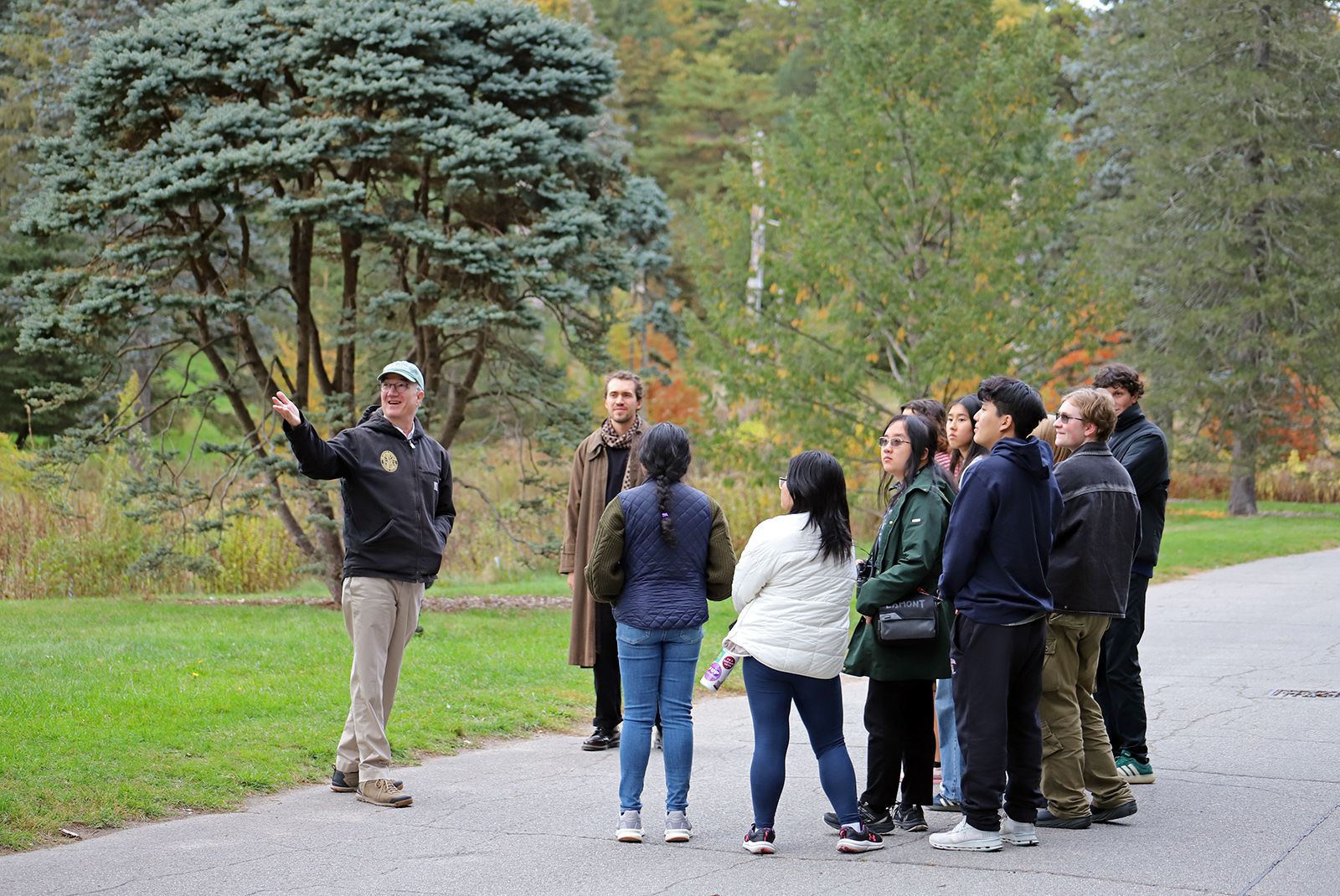
Arnold Arboretum Director and Arnold Professor of Organismic and Evolutionary Biology William (Ned) Friedman leads an innovative first-year seminar for Harvard students called “Tree.” Through weekly classes, the course encourages students to engage deeply with individual trees at the Arboretum—an approach that echoes our mission of fostering curiosity, connection, and stewardship through close observation of nature.
Ned encourages us all to get to know one tree intimately to return to again and again through the seasons. Every visit to the Arboretum offers the chance to slow down and attend to another living being, leaf by leaf and from root flares to crown. It’s a practice that can transform how we view humanity itself and tap into a deeper sense of belonging within the wider living world.


Interested in learning more?
Read the New York Times profile of the course from February 2026. View the reading list below, or click here for the full course syllabus. And check out the Arboretum’s many public programs!
“Tree” Reading List
- Week 1: What is a tree? Can the essence of a tree be defined?
- Tudge C. (2005) What is a tree? In: The Tree: A Natural History of What Trees Are, How They Live, and Why They Matter. New York: Crown Publishing Group. Pages 3-12, 15-20.
- Kress, W. J. (2024) What is a tree? In: Smithsonian Trees of North America. New Haven: Yale University Press. Pages 2-8.
- Friedman, W.E. 2021. Seeing life: re-engaging with nature. Harvard Magazine March-April: 36-43.
- Week 2: Birth of the concept of an arboretum; birth of the Arnold Arboretum
- Loudon, J., & Strutt, J. (1840) The Derby arboretum containing a catalogue of the trees and shrubs included in it, a description of the grounds and directions for their management, a copy of the address delivered when it was presented to the town of Derby, by its founder, Joseph Strutt, esq., and an account of the ceremonies which took place when it was opened to the public, on Sept. 16, 1840. London: Longman, Orme, Brown, Green & Longmans. Pages 7-10 & 71-85.
- Hay, I. (1994) George Barrell Emerson and the Establishment of the Arnold Arboretum. Arnoldia 54(3). Pages 12-21.
- Friedman W.E., Dosmann, M.S., Boland, T.M, Boufford, D.E., Donoghue, M.J., Gapinski, A., Hufford, L., Meyer, P.M., and Pfister, D.H. (2016) Developing an Exemplary Collection: A Vision for the Next Century at the Arnold Arboretum of Harvard University. Arnoldia 73(3). Pages 2-18.
- Week 3: Intertwining trees and families
- Powers, Richard. (2018). Nicholas Hoel. In: The Overstory. New York: W.W. Norton & Company. Pages 5-23.
- Kimmerer, Robin Wall. (2013). The Council of Pecans. In: Braiding Sweetgrass. Pages 11-21.
- Miles, Tiya. (2021). Ashley’s seeds. In: All that She Carried. New York: Random House. Pages 193-223.
- Week 4: The origins of arborescence: an evolutionary historical perspective
- Lucretius Carus, T., & Copley, F. (2011) Book V. In: On the Nature of Things. New York: W.W. Norton. Pages 126 (line 596)-134 (line 924).
- Stein, W., Berry, C., Morris, J., Hernick, L., Mannolini, F., Ver Straeten, C., … Leake, J. (2020) Mid-Devonian Archaeopteris roots signal revolutionary change in earliest fossil forests. Current Biology 30: 421-431.
- Week 5: Roots, the unseen half (architecture and symbioses)
- Perry, T. (1989). Tree roots: facts and fallacies. Arnoldia, 49(4), 2-21.
- Lyford, W.H. and B.F. Wilson. (1964). Development of the root system of Acer rubrum L. Harvard Forest Paper No. 10.
- Check out this amazing website on roots: https://images.wur.nl/digital/collection/coll13
- Week 6: Bonsai
- The Larz Anderson Bonsai Collection, Arnoldia 64 (2-3), 2006.
- Week 7: Autumn colors: the ongoing mystery of why?
- Lee, David W, & Gould, Kevin S. (2002). Why leaves turn red. American Scientist 90: 524-531.
- Renner, Susanne S, & Zohner, Constantin M. (2019). The occurrence of red and yellow autumn leaves explained by regional differences in insolation and temperature. New Phytologist 224: 1464-1471.
- Have a look at this website: https://vtecostudies.org/blog/abscission-and-marcescence-in-the-woods/
- Healy, N. (2022). Diptych: Abscision and Marcescence. Scientific American October 2022: 24.
- Week 8: Trees move! Global migrations of temperate trees
- Selected correspondence between Asa Gray and Charles Darwin on disjuncts.
- Yih, D. (2012). Land Bridge Travelers of the Tertiary: The Eastern Asian-Eastern North American Floristic Disjunction. Arnoldia, 69(3), 14-23.
- Lord, B. (2015). The great forest migration. Northern Woodlands, Spring Issue, 26-33.
- Davis, M.B. and R.G. Shaw. (2001). Range shifts and adaptive responses to quaternary climate change. Science 292: 673-679. Don’t read, just look at figure 1.
- Check out these gif animations for last 20,000 years of pollen records of North American trees: https://www1.ncdc.noaa.gov/pub/data/paleo/pollen/viewer/animated-gifs/
- Week 9: Should trees have legal standing?
- Stone, C. (2010). Introduction and Should Trees Have Standing? In: Should Trees Have Standing: Law, Morality, and the Environment (3rd ed.). Oxford University Press. Pages xi-xvi and 1-31.
- McCullers, C. (2005). A tree, a rock, a cloud. In: The ballad of the Sad Café and Other Stories. Boston: Houghton Mifflin. Pages 141-152.
- Week 10: How to read a tree and contemplating the meaning of tree longevity
- Core, E.L. & Ammons, N.P. (1958) Woody plants in winter. In: Woody Plants in Winter. pp. 1-15.
- Hitch, C. (1982). Views: Dendrochronology and Serendipity: An astronomer’s simple but ingenious technology failed in its original objective but achieved unforeseen and astounding successes. American Scientist 70(3): 300-305.
- Liu, J., Yang, B. & Lindenmayer, D. (2019) The oldest trees in China and where to find them. Frontiers in Ecology and the Environment 17(6): 319-322.
- Wagoner, D. (1999). Stump speech. In: Traveling light: Collected and new poems. Urbana: University of Illinois Press.
- Have a look at these websites: