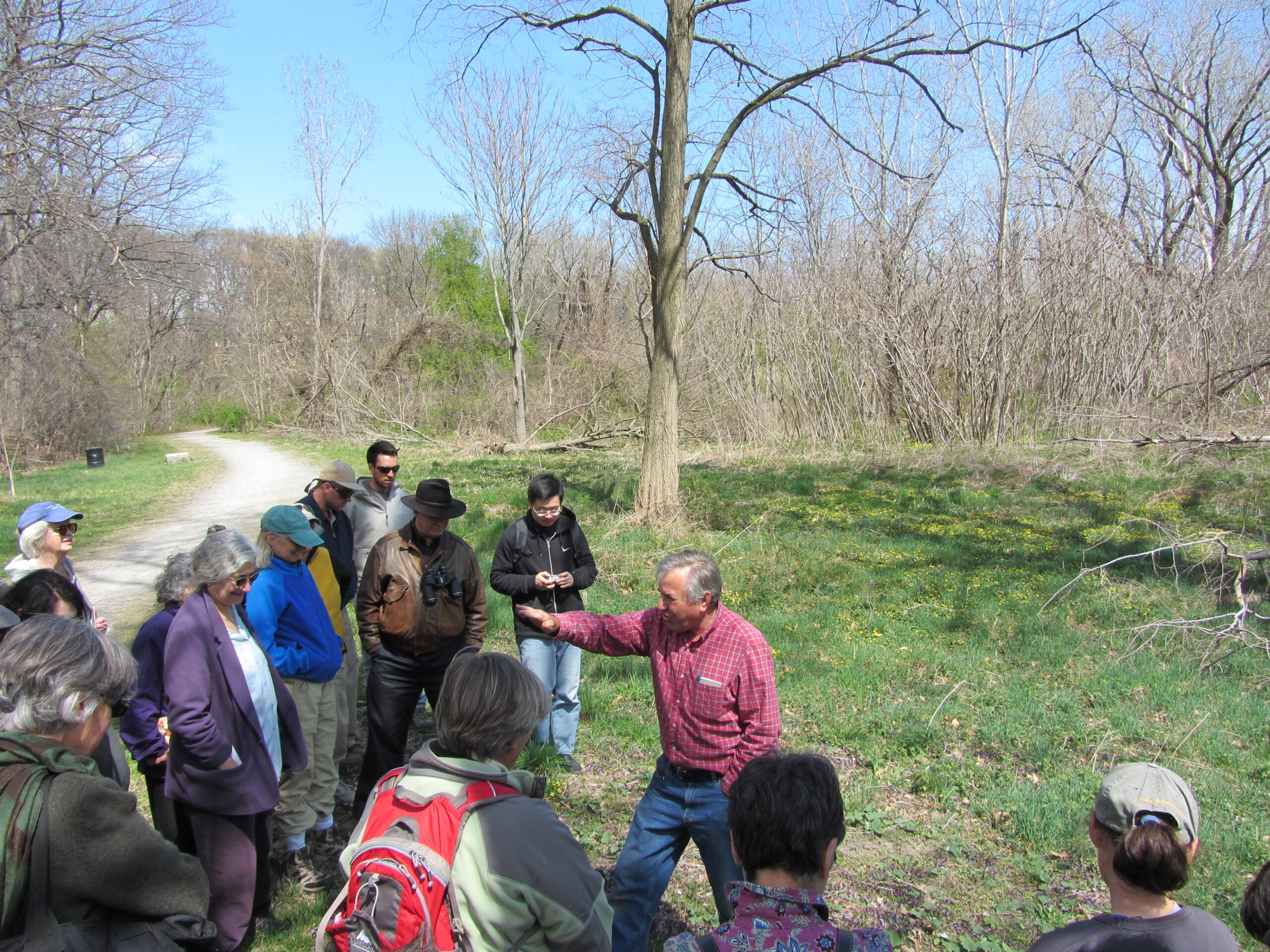
Much of what is now the Arnold Arboretum was once part of Benjamin Bussey’s farm (until 1842), and before that the ground had been farmed by Eleazer Weld. In 1692, a small saw mill operated along the banks of Bussey Brook at the base of Hemlock Hill, turning virgin timber into lumber. In other words, the land comprising the Arboretum has a land-use history going back some two hundred years before the Arboretum was established.The spontaneous vegetation that exists here today—which is defined as any plant that grows in an area without assistance from humans—reflects not only the agricultural history of the land but also its long horticultural history.
It includes species native to a variety of New England habitats, and species from Europe that were brought here during the colonial period for medicinal, ornamental or agricultural purposes (along with “weedy” species that contaminated their seed). There are also a number of species from Asia, mainly woody and originally planted for landscape purposes, that managed to escape from cultivation and spread throughout the area by various means of dispersal (e.g., wind, water, animal). In short, the Arboretum’s spontaneous vegetation is a cosmopolitan mix of species that reflects the complex social and ecological history of the land itself.
Seed-bearing Plants
The Herbarium of Cultivated Plants at the Arnold Arboretum houses the Spontaneous Flora Collection.
Click here to view a list of seed-bearing plant species recorded at the Arnold Arboretum using iNaturalist.
Related Articles & Resources
- Keegan, B. 2020. Beyond the Trees: An Herbaceous Shift at the Arnold Arboretum. Arnoldia 2020 77 (3): 6-13. [pdf]
- Del Tredici, P. 2010. Excerpts from Wild Urban Plants of the Northeast. Arnoldia 68(1): 13-25 [pdf]
- Dalton, P.A., Novelo, A.R. 1983. Aquatic and Wetland Plants of the Arboretum. Arnoldia 43(2): 7-44. [pdf]
- Green, P.S. 1962. Herbaceous Aliens in the Arboretum. Bulletin of Popular Information. 22(7): 49-56. [pdf]
- Palmer, E.J. 1930. The spontaneous flora of the Arnold Arboretum. Journal of the Arnold Arboretum. 11: 63-119. [pdf]
- Palmer, E.J. 1935. Supplement to the spontaneous flora of the Arnold Arboretum. Journal of the Arnold Arboretum. 16: 81-87. [pdf]
- Palmer, E.J. 1947. Second supplement to the spontaneous flora of the Arnold Arboretum. Journal of the Arnold Arboretum. 28: 410-418. [pdf]
Spore-bearing Organisms
Ferns
List compiled by Don Lubin (b. 1943 – d. 13 Jan 2025, [pdf]) and Arboretum staff.
- Lady fern (Athyrium filix-femina)
- Interrupted fern (Claytosmunda claytoniana)
- Hayscented fern (Dennstaedtia punctilobula)
- Intermediate wood fern (Dryopteris intermedia)
- Spinulose fern (Dryopteris carthusiana)
- Horsetail (Equisetum arvense)*
- Ostrich fern (Matteuccia struthiopteris)
- Sensitive fern (Onoclea sensibilis)
- Cinnamon fern (Osmundastrum cinnamomea)
- Royal fern (Osmunda regalis)
- Appalachian polypody (Polypodium appalachianum)*
- New York Fern (Parathelypteris noveboracensis)
- Bracken fern (Pteridium aquilinum)
All except (*) occur at the Arnold Arboretum between Bussey Brook and Hemlock Hill.
Click here to view a list of fern and horsetail species recorded at the Arnold Arboretum using iNaturalist.
Related Articles & Resources
- Keogh, L. 2017. The Wardian Case: How a Simple Box Moved the Plant Kingdom. Arnoldia 74 (4): 2-13. [pdf]
- Del Tredici, P. 1996. Bulldozers and Bacteria: The Ecology of Sweet Fern. Arnoldia 56 (3): 3-11. [pdf]
- Angelo, R. 1985. Thoreau’s Climbing Fern Rediscovered. Arnoldia 45(3): 24-26. [pdf]
- Brumback, W. E. 1985. Raising the Climbing Fern from Spores. Arnoldia 1985 – 45 (3): 27-29. [pdf]
- The American Fern Society
Fungi
List compiled by Arboretum staff.
- Black knot fungus (Apiosporina morbosa)
- Yellow patches fungus (Amanitas flavoconia)^
- Tawny grisette (Amanitas fulva)^
- Grisette (Amanitas vaginata)^
- Red chantrelle (Cantherellus cinnabarinus)
- Shaggy mane mushroom (Coprinus comatus)
- Bird’s nest fungus (Crucibulum spp. and Cyathus spp.)
- Thin maze fungus (Daedaleopsis confragosa)^
- Fomes fomentarius^
- Dog vomit slime mold (Fuligo septica)
- Artist’s conk (Ganoderma applanatum)^
- Hemlock varnish shelf (Ganoderma tsugae)^
- Hen of the woods (Grifola frondosa)
- Lactarius hygrophoroides^
- Chicken of the woods (Laetiporus sulphureus)
- Indian pipe or ghost pipe (Monotropa uniflora)
- Bark mycena (Mycena spp.)
- Mower’s mushroom (Panaeolus foenisecii)^
- Luminescent pan or bitter oyster (Panellus stipticus)^
- Dryer’s (Phaeolus schweinitzii)^
- Common oyster mushroom (Pleurotus ostreatus)
- Pheasant’s-back polypore or dryad’s saddle (Polyporus squamosus)
- Stinky squid (Pseudocolus fusiformis)
- Crusty russula (Russula crustose)^
- Red fungus (Russula sp.)^
- Burgundy mushroom or wine cap (Stropharia rugosoannulata)^
- Tuber arnoldianum
- Turkey tail (Trametes versicolor)^
- Witch’s butter (Tremella mesenterica)
- Violet tooth (Trichaptum biforme)^
- Bitter bolete or bitter tylopilus (Tylopilus felleus)^
- White cheese (Tyromyces chioneus)^
^Found on a mushroom foray sponsored by and at the Arnold Arboretum and the Boston Mycological Club in late June 2018.
Click here to view a list of fungus and lichen species recorded at the Arnold Arboretum using iNaturalist.
Related Articles & Resources
- Healy, R. 2014. Reading Tree Roots for Clues: The Habits of Truffles and Other Ectomycorrhizal Cup Fungi. Arnoldia 72 (2): 33-39. [pdf]
- Richardson, K. 2009. A Closer Look at Fungi in the Arnold Arboretum. Arnoldia 66 (4): 13-21. [pdf]
- Reed, C. “Don’t Eat Amanitas.” Harvard Magazine September-October 2010: 72.
- North American Mycological Association
Lichens
List compiled by Steve Schneider, former Director of Operations at the Arnold Arboretum, using a line-transect survey method on Peters Hill.
- Cup lichen (Cladonia macileata)
- Stilling’s disc (Buellia stillingiana)
- Candle flame (Candelaria concolor)
- Greenshield (Flavoparmelia caperata)
- Lecanora sp.
- Eyelash lichen (Parmotrema sp.)
- Pertusaria sp.
- Mealy rosette (Physcia millegrana)
- Punctelia rudecta
- Punctelia subrudecta
- Ramalina sp.
- Usnea strigosa
Click here to view a list of fungus and lichen species recorded at the Arnold Arboretum using iNaturalist.
Related Articles & Resources
- Weaver R.E. 1975. Lichens: Mysterious and Diverse. Arnolida 35(3): 133-159. (pdf)
- Raup, H.M. 1933. Lichens. Bulletin of Popular Information no 3, March 15, 1933. (pdf)
- American Bryological and Lichenological Society
Mosses
Read more about the The World of Mosses by Stephanie Stuber, former Curatorial Fellow at the Arnold Arboretum.
Photo Gallery


