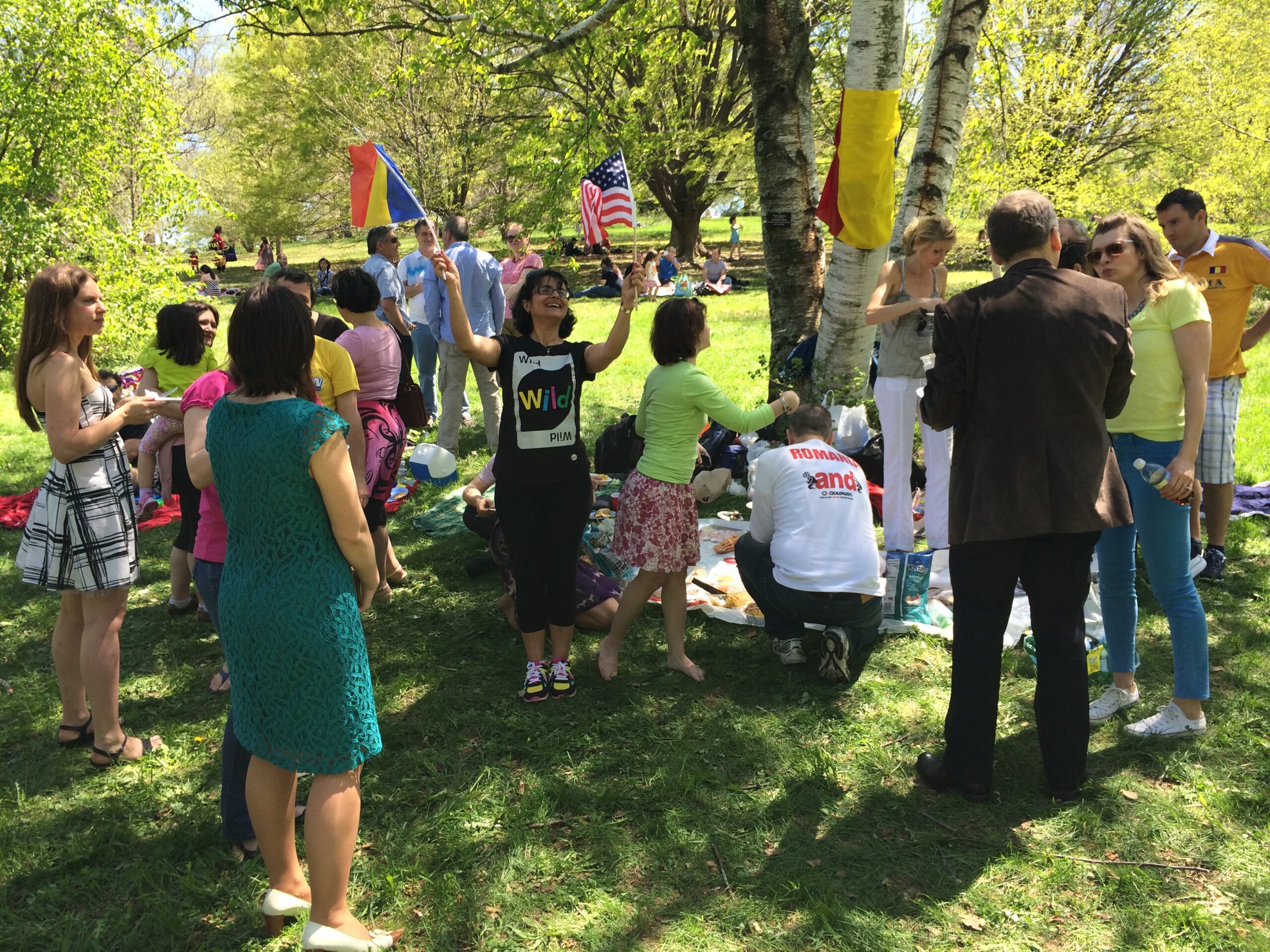
On May 8, 2011, my very first Lilac Sunday at the Arnold Arboretum, I learned something profound bout plants. Lilac Sunday is the only day of the year when picnicking is allowed in the Arboretum. Many families and groups of friends gather on the grounds, with homemade meals brought in tote bags and picnic baskets. Often, these clusters of people gravitate to the slopes of Bussey Hill, behind the lilac collection. As I wandered from the lilacs into the birch collection that day, I encountered a group of people who had hung a national flag from one of the Arboretum’s birch trees. I introduced myself and asked what country the flag represented. It was the flag of Romania.
So, why this spot, why this birch? It was an accession of downy birch (Betula pubescens), a widespread native of northern Europe and Asia. Some consider there to be a subspecies, the Carpathian birch, which grows in the Carpathian Mountains, including in Romania. This spot was where the Association of Romanians in New England gathered to delight in the beauty of the Arnold Arboretum, each other’s company, and to conjure memories of an ancestral homeland far away, with all manner of Romanian delicacies to be shared. That wonderful three-trunked “Carpathian birch” was the tree that brought everyone and everything together.
My visit with my Romanian American friends has now become a Lilac Sunday tradition. I join them every year next to the Romanian flag, hung from the downy birch, and they ply me with amazing food. Interestingly, the Arnold Arboretum has recently added wild-collected common lilac (Syringa vulgaris) from Romania to its living collections. The seed originally hailed from Mehenditi, Romania, and these shrubs now augment the three near-centenarian common lilacs collected in the wild in Romania in 1934. Of the ten species and 120 wild-collected accessions of the lilac genus (Syringa) to grace the grounds of the ArnoldArboretum, you will find specimens that come from China, South Korea, North Korea, Romania, Afghanistan, India, and Bulgaria. Each has a story to tell.
This initial chance interaction with New England Romanian Americans in 2011 marked the beginning of my education about what a living collection of trees from around the world can do to connect people witheach other and with biological and cultural history around the world. Visit the Bradley Rosaceous Collection at the peak of cherry blossom season and you will see Japanese and Japanese Americans delighting in memories of cherry blossom festivals in Japan. Stop by the dove tree (Davidia involucrata) from China and imagine how wonderful it is to see Chinese and Chinese Americans, especially those who grew up in its native range in central and eastern China, visiting with a tree that signifies “home.” The seeds that gave rise to our living collections hail from 55 different countries. It is the very stories of native homelands and ecologies, cultural affinities, and journeys to the Arnold Arboretum that make the our living collections the equivalent of botanical ambassadors.
Just as I have come to understand the ambassadorial role that plants can play in the human world, I am now committed to helping the broader public see international botanical collections not just as scientific or horticultural collections for aesthetic display, but as living, breathing (well, photosynthesizing) plants that can play a powerful role in reminding us that we are all citizens of the world. This story has roots that go back over a century, and it continues to reverberate today.
In 1902, Tomijiro Uchiyama, a Japanese botanist, plant collector, and director of the Koishikawa Botanic Garden (now the Botanical Garden of the University of Tokyo) travelled to Korea (this was his second journey to Korea, the first being in 1900) to collect plants, typically in the form of herbarium specimens and germplasm (seeds), for scientific description and basic taxonomic work. Ultimately, 41 of the taxa collected by Uchiyama would represent species newly described to science. All of these collected plant materials would be sent to the University of Tokyo.
In December of 1904, Arnold Arboretum plant records show the receipt of seeds of 32 species from Uchiyama’s 1902 plant collecting trip to Korea. More than 120 years later, most have perished, but 14 accessions representing seven species from these seeds still grace the grounds of the Arnold Arboretum, including two wonderful ginkgo trees that frame the historic gate at Walter Street.
It is the very stories of native homelands and ecologies, cultural affinities, and journeys to the Arnold Arboretum that make our living collections the equivalent of botanical ambassadors.
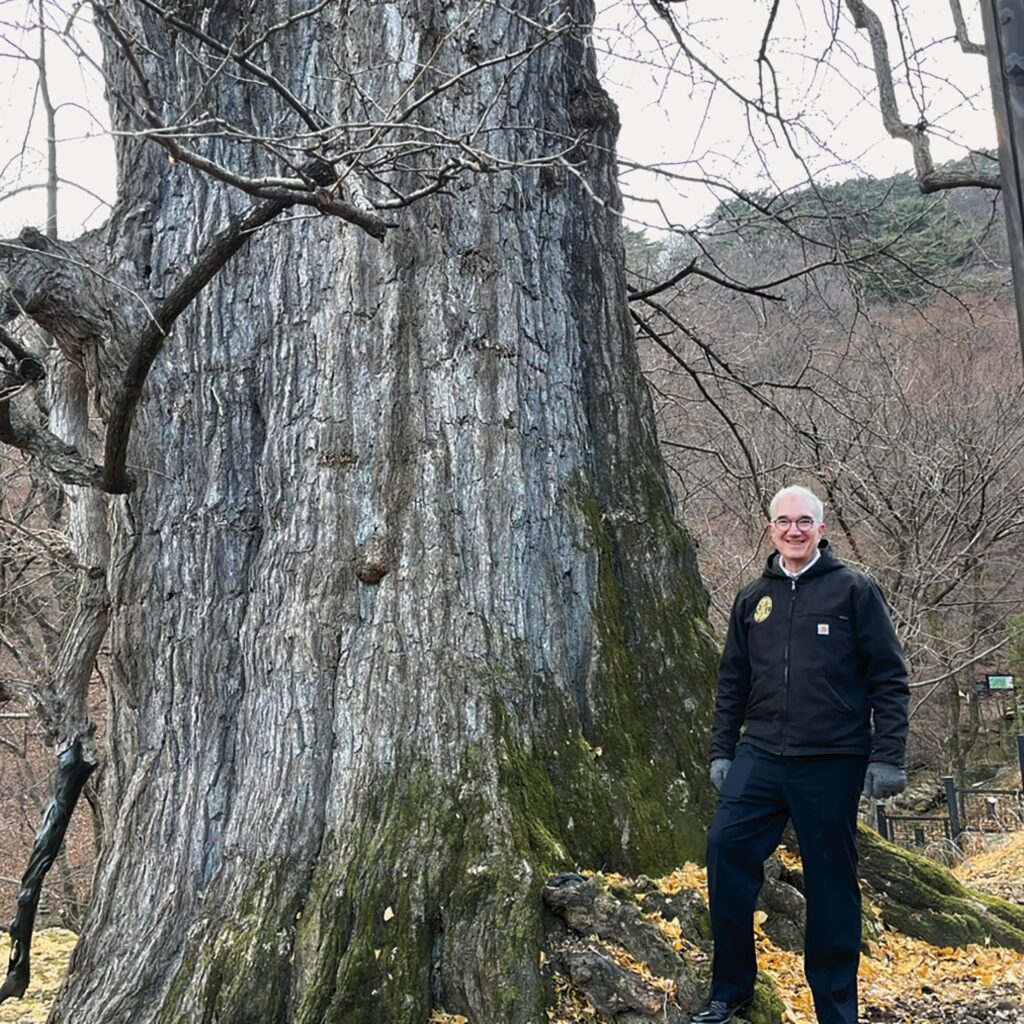
When we examine the list of species Uchiyama shared with the Arnold Arboretum, we discover that only one of these 32 species, Ginkgo biloba, was not native to Korea. However, this relictual native of China had already thoroughly embedded itself in Korean culture and horticulture, a result of a much earlier human-assisted plant journey in the sixth century from China to Korea. The seeds of Ginkgo biloba that were received by the Arnold Arboretum from Uchiyama’s botanical expedition in Korea may well have come from a tree in a Buddhist monastery. Many Korean mon-asteries have iconic and often very ancient ginkgo trees. Indeed, last December, when I was in the Republic of Korea, my very gracious hosts from the Korea National Arboretum took me to Yongmunsa Temple (established in the year 913), where I had the amazing experience of spending time with a 1,000 plus year-old seed-bearing ginkgo tree.
How do two ginkgo trees collected as seeds by a Japanese botanist in Korea in 1902 and received at the Arnold Arboretum in 1904, probably planted in 1915, relate to the story of plants as ambassadors? Fast forward to 2023 and my first-year seminar “Tree.”
Each week, the students read a selection of materials relating to trees—ranging from fiction, cultural narratives, poetry, environmental law, biogeography, the evolutionary history of arborescence (yes, there once was a time when there were no trees), and scientific literature centered on the mysteries of why eastern North American trees have more vibrant colors in the fall than do comparable species in Europe. Importantly, each student must choose one tree (among the 16,000+ woody plant accessions at the Arnold Arboretum) to observe every week and provide an anno- tated set of images of what they “see.” On one of our first walks as a class in the Arboretum, I mentioned the story of these two wonderful trees from Korea. When each student wrote to tell me which tree they would be observing, one of the students, a Korean American student, had chosen the male (the other being female) Korean ginkgo tree by Walter Street Gate.
As I learned later in the semester, this student’s parents and his grandmother visited on Parents’ Weekend at Harvard College. He brought them to the Arnold Arboretum to see his Korean ginkgo tree. It was there that his grandmother, who had grown up in South Korea after the Korean War, related a story of her girlhood, when she and her friends would collect the golden ginkgo leaves after they had fallen to the ground in the autumn. Amazing. A ginkgo tree, not a sentient being, not able to “think” or “talk” to us, was connecting a grandson to his grandmother and to Korean culture and heritage—surely a beautiful symbol of plant ambassadorhood!
This plant diplomacy goes well beyond connecting the world’s diasporas in the Boston area to their native or ancestral homelands or cultures. I have lived my entire life in the United States, but I love ginkgo trees (I even did my Ph.D. dissertation on Ginkgo biloba), and cannot imagine a world where I would not get to be with ginkgo trees and their amazing fall foliage or smelly seeds. Or a world where I could not regularly witness some of my favorite winter barks, such as the Korean stewartia (Stewartia pseudocamellia) or the lacebark pine (Pinus bungeana—a native of China, but with magnificent specimens that grace the grounds of the Secret Garden of Changdeokgung Palace in Seoul and the Arnold Arboretum in Boston). Or a world that did not offer me the opportunity to witness the Chinese dawn redwood (Metaseqouia glyptostroboides) as its needles turn a magnificent copper before dropping from the tree. These trees draw me to places far away and encourage me to learn of the cultures around the world that are their native homelands. Trees from around the world can reciprocally serve as plant ambassadors to their native homelands, inviting the rest of the world to query the botanical and cultural riches of countries far away.
Just this past month, a package bearing seeds from the Arboretum’s fall 2025 plant-collecting expedition to South Korea (with our keeper of the living collections, Michael Dosmann, working alongside colleagues from the Korea National Arboretum, Mokpo University, and Sunkyunkwan University) arrived at the Arnold Arboretum. Imagine the stories these trees will tell at the Arnold Arboretum for centuries to come: of the biodiversity of Korea and cultural associations that Koreans have with these plants.
These trees draw me to places far away and encourage me to learn of the cultures around the world that are their native homelands.
In these highly nationalistic times, plants serve as a powerful counternarrative to the notion of each nation unto itself. When the Arnold Arboretum goes into the field to collect, we never go alone. We always partner with local botanical experts: in China, with our friends and colleagues from the National Botanical Garden in Beijing, Zhejiang University, Kunming Institute of Botany, Chengdu Institute of Biology; in Japan, with our amazing friend and colleague Professor Mineaki Aizawa and his graduate students from Utsunomiya University; in the Republic of Georgia with botanists from the National Botanical Garden of Georgia (in Tbilisi) and the Batumi Botanical Garden; and so many others, with more and more to come. Meals are shared, culture is shared, the joys of collecting and sharing plants with the world are shared. Every journey is one of utter devotion to the beauty of plants. Just as importantly, every journey crosses national borders and binds us to each other in ways that reinforce our commonalities while also celebrating our botanical and human cultural differences.
Yes, plants may actually be the ultimate ambassadors!