The practice of observing life in its natural environment—natural history—is what inspired me to become a biologist. For me, science starts with paying attention: watching a plant bloom, noticing which insects visit it, and observing how a landscape changes through the seasons. Careful observation must happen before hypothesizing or experimenting. After all, how could we ask why something happens if we haven’t first noticed that it does happen?
In the Hopkins Lab at the Arnold Arboretum, we study plant evolution. Our research typically focuses on how and why new species form. For example, in the Texas wildflower Phlox drummondii, we study how and why floral color has evolved to prevent pollen movement between it and a closely related Phlox species. Targeted research questions like this are made possible by naturalists before us who have taken the time to document patterns in nature—in this case, people like Dr. Don Levin and Dr. Eula Whitehouse, who spent years describing floral color variation in Texas Phlox. Their natural history work laid the foundation that allows us to ask “why” and “how” for our Phlox research today.
For me, natural history is more than a scientific tool: it’s also a personal joy. This
past summer, I spent hours at the Weld Hill Solar Meadow watching bumblebees at my favorite wildflower species, Monarda fistulosa. I took notes, pictures, and videos of how individual bees foraged from one flower to the next, sometimes circling the same plant over and over. Before long, some patterns started to emerge: certain
bees focused on nectar collecting from the mouths of the flowers, others focused on
gathering pollen at the anthers, and still others dug holes in the base of the flower tubes to “rob” the nectar. These quiet hours in the sun, meditating with the bugs, plants, and birds, are my inspiration as an evolutionary biologist.
I’m not alone in this enjoyment. Today, millions of people participate in community science, a modern way of collectively compiling our natural history collections. The best-known example of community science is iNaturalist, an online platform through which anyone can upload photos of the living things they encounter, whether in their backyard or on a trip abroad. When uploaded, photos of an individual organism immediately become an “observation,” being tagged with a date and time and a GPS
point, and eventually getting labeled with an identification by one of the many nature enthusiasts browsing the website. iNaturalist provides a way for anyone to learn about local species, meet fellow naturalists, and feel connected to global biodiversity. It is also a goldmine of data with enormous potential for career scientists.
Quiet hours in the sun, meditating with the bugs, plants, and birds, are my inspiration as an evolutionary biologist.
Much of my own early experience with iNaturalist came from the community side: encouraging people to get outside, explore their local habitats, and start noticing the plants and animals around them. I sought to encourage other people to, like me, find
inspiration in observing nature. But as a researcher, I have now learned to appreciate the value of iNaturalist data for science as well. For years, iNaturalist has emphasized its potential for research with promises of participating in the scientific process and making important contributions to the research enterprise. I can attest that the research potential of this platform is finally being realized, and I have personally found it to be transformative for my ability to answer some fundamental biological questions.
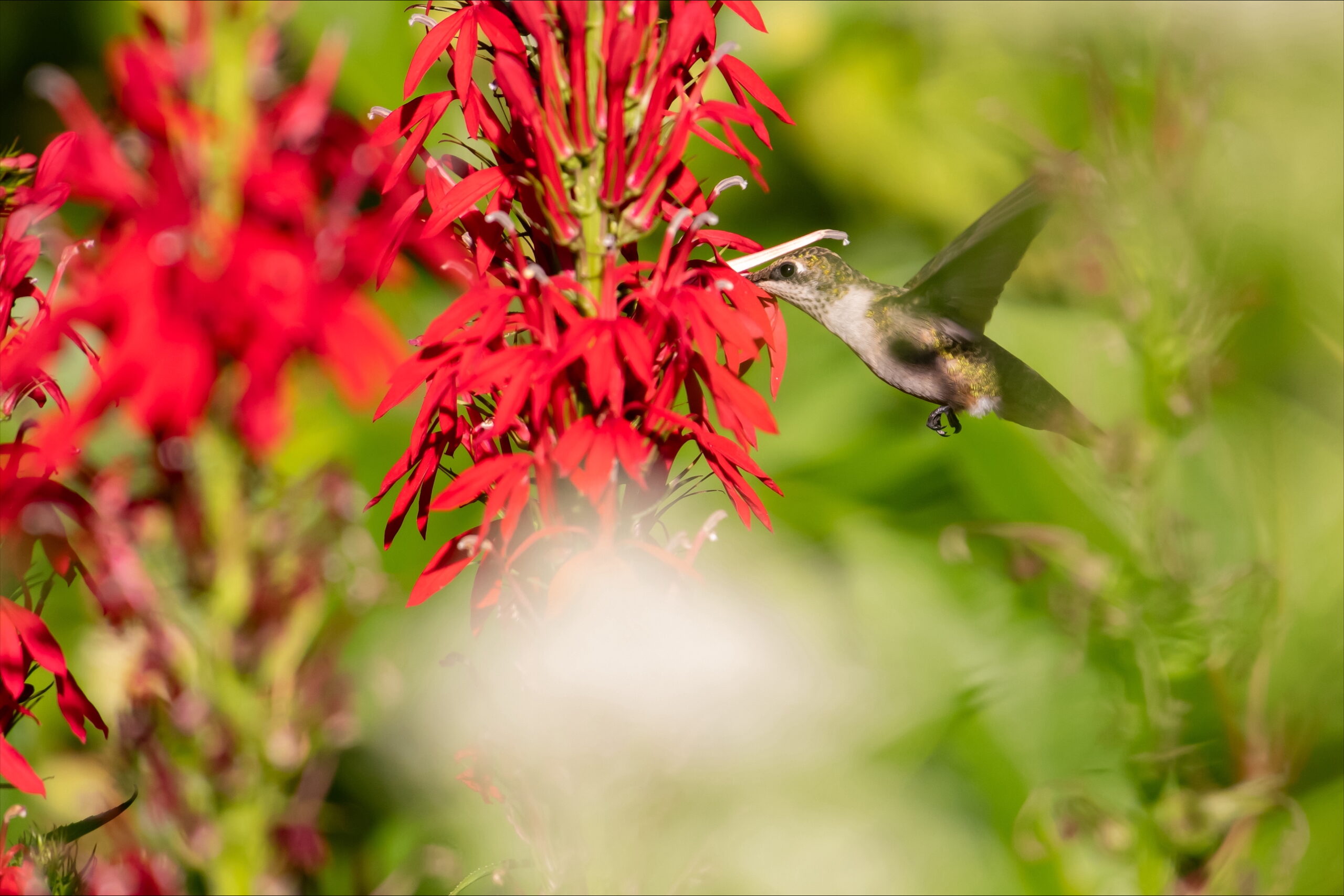
For example—I have always been interested in the classic pollination biology concept that certain flower traits are associated with specific pollinators. Red flowers are preferentially visited by hummingbirds, which also favor tubular, nectar-rich blooms. But what about the timing of flowering? In eastern North America, rubythroated hummingbirds are present only during the warm months, migrating north each spring. This led me and my collaborators to wonder: have red and orange flowers evolved to synchronize their blooms with the arrival of their hummingbird pollinators? Hummingbirds arrive later in the year than the onset of overall spring flowering, so we hypothesized that red-flowered plants would bloom later than plants with other flower colors.
Addressing this hypothesis in the field would require monitoring flowering times across thousands of locations over the entire spring season—a challenging proposition! Herbarium specimens are also of limited use, since flower color fades after pressing and even the broadest collections might not capture the sheer number of observations needed to reveal such a pattern. With iNaturalist, however, we were able to use over 1.6 million observations of plants in bloom across the continent. We categorized flowers from this giant dataset into color groups (red, orange, yellow, white, blue, etc.) and then compared their flowering times.
What we found was strikingly clear. Across the eastern United States, flowers
of all colors generally bloom in synchrony, early in the spring. . . except red and orange. These colors bloom noticeably later, coinciding almost perfectly with the northward migration of hummingbirds. It’s an elegant and almost obvious pattern in retrospect, but one that we could only detect using a dataset at this scale.
This study also highlights the technological advancements that allow us to efficiently analyze the abundance of community science data. I would have needed countless collaborators with endless patience to sort through every plant species in our dataset and determine its flower color. But thanks to emerging computer vision models, we were able to identify the color of each plant species in our dataset in a matter of hours.
Extending this research, I and collaborators developed tools for studying subtle color
variation in observations of the widespread species Monarda fistulosa. This charismatic native wildflower, beloved by pollinators and gardeners alike, is found across the eastern U.S., stretching northwestward into Canada and then all the way down the Rocky Mountains to Arizona. Monarda is a fascinating group for evolutionary biology, featuring hybridization between species, taxonomic puzzles, and variation in floral traits like color and scent. Anecdotally, botanists have
suggested that the flowers of western M. fistulosa are a richer, darker purple than their eastern counterparts, but the difference is subtle enough that it was never documented formally.
Once again, the breadth of data on iNaturalist offered a solution. We downloaded over 40,000 images of M. fistulosa, and we used computer vision to isolate the flowers from each picture and summarize their color. The result was a clear, continent-scale pattern of flower color variation: western plants really are consistently deeper purple than those in the east. We were excited to see that this color shift lines up with a known division between recognized varieties—M. fistulosa var. menthifolia in the west and var. fistulosa / var. mollis in the east—providing the first formal evidence that flower color can help distinguish them.
Our results—whether demonstrating that red flowers are timed for hummingbirds, or that western Monarda flowers are a richer shade of purple—are, at their heart, natural history. I was able to synthesize previously uncharacterized patterns in the living world, only because of enormous community datasets and modern analytical tools. But describing these patterns is only the beginning, serving to unlock more questions: is the delayed appearance of red and orange flowers in the eastern U.S. uniformly distributed across phylogeny, or is it driven by a bunch of closely related species? Did western M. fistulosa evolve its deeper purple flowers due to pollinator preferences, abiotic factors like UV exposure, or simply by random drift? These are the kinds of questions we couldn’t even pose without first observing the patterns themselves.
When smartphones first put a digital camera in everyone’s pocket, scientists quickly recognized the potential: a global network of observers who could help document the living world. Today, iNaturalist has matured into a resource that is transformative for how we practice natural history.
With iNaturalist, anyone with a phone and curiosity can make an observation that becomes part of a permanent biodiversity record.
To me, one of the most exciting aspects of community science is the way it democratizes science. With iNaturalist, anyone with a phone and curiosity can make an observation that becomes part of a permanent biodiversity record. You don’t have to live near a university herbarium or be a trained botanist to contribute valuable data. Recording observations with cell phone pictures is much simpler than collecting a specimen, which lowers the bar for participation. And for those who are geographically distant from major collections, iNaturalist still offers the ability to engage with biodiversity data at massive scales from home.
Of course, iNaturalist is not a replacement for traditional fieldwork or collection. Classic natural history has a depth that can’t be replicated by a photograph: spending time in the field allows you to touch the plant, smell it, record its visitors, and see its full context in the landscape. But iNaturalist offers something different: breadth. It allows us to see patterns across regions, seasons, and years. This breadth enables us to detect large-scale phenomena like the synchronized timing of red flower blooms with hummingbird migrations or subtle geographic differences in flower color that would be undetectable at the scale of a single field site.
As its userbase grows, I expect that iNaturalist will play an even greater role in shaping the questions we can ask about nature. It will help us fill in missing pieces of our understanding of biodiversity, from broad patterns to targeted discoveries of new or rare species. And perhaps most importantly, it will continue to connect people
with the natural world and to the scientists who study it, empowering anyone, anywhere, to participate in the grand project of learning more about life on Earth.
Patrick McKenzie is a postdoctoral researcher in Robin Hopkins’ lab at Harvard University, where he studies the evolutionary genomics and natural history of flowering plants.