One of Alfred Stieglitz’s best-known photographs was taken during a winter storm in 1903. It’s one of those images that lives in collective memory, easy to find online, yet when I saw it the other day—while flipping through a bin of framed prints at a flea market—I was surprised by its title. The Flatiron, 1903, it’s called—but to me, it has always been a photograph of a tree.
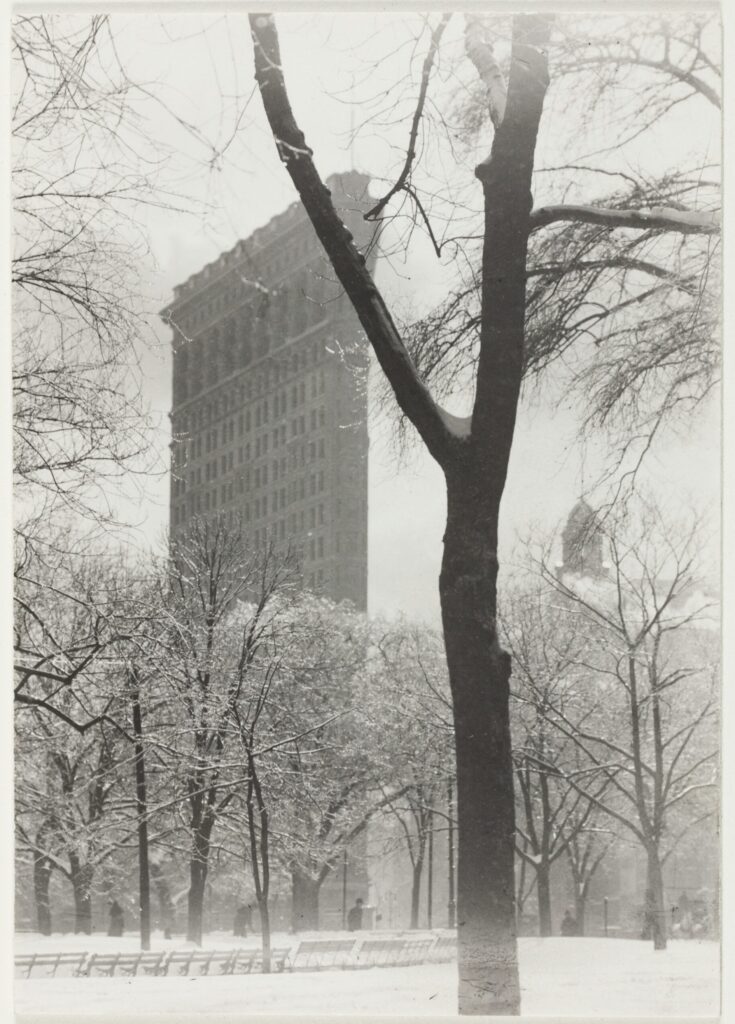
Your eye travels to it first, that immense tree in the foreground—likely an American elm (Ulmus americana). It’s a young tree, forked, cusping snow, confidently growing up and out of the frame. If its secondary branch seems to gesture toward the Flatiron, its belly nudges you toward its elders, the other trees in the promenade, their hundreds of branches forming a fine mesh of lace. A few versions of The Flatiron, 1903, exist. The one I saw at the flea market that day was an early print. Stieglitz had cropped the composition, cut out other buildings and beings so that the Flatiron runs near the left edge of the frame, the tree along its right. It’s a photograph of the two of them alone it seems—two bodies in melancholic conversation.
According to Stieglitz, when his father saw his Flatiron photograph, he remarked, “I do not see how you could have produced such a beautiful thing from such an ugly building.” Even Stieglitz, who had spent the past two decades photographing the new New York, had not considered the Flatiron a worthy subject. When reflecting on that winter day in 1903 he wrote:
I stood spellbound as I saw that building in that storm. I had watched the structure in the course of its erection, but, somehow, it had never occurred to me to photograph it in the stages of its evolution. But that particular day, with the trees of Madison Square all covered with snow—fresh snow—I suddenly saw the building as I had never seen it before. It looked, from where I stood, as though it were moving toward me like the bow of a monster ocean-steamer—a picture of the new America that was still in the making.
I imagine him standing there, spellbound, on that wintry day. Maybe, to protect the camera from the elements, he held it close to his chest, under his coat, with only the lens poking through. As he looks down into the viewfinder, he glimpses the tips of his mustache, turned to ice under his breath. The city mute now, birdsong, hollering shopkeeps, police whistles, car horns, all quieted except for the clop and roll of the horse-drawn carriage. In 1903, he was around thirty-nine years old, his daughter Katherine—“Kitty”—was five. Had he been seeing with her eyes too?
It’s a photograph of the two of them alone it seems—two bodies in melancholic conversation.
Stieglitz had spent his own childhood in New York and then moved to Berlin for several years before returning to New York in 1890, a photographer. These were the later years of the Gilded Age and Stieglitz watched as the new New York, with its skyscrapers and public parks and glamorous facades, essentially rose up from the earth. Early on, he had the idea that he would document the city’s transition from old to new. “… (O)ne hundred photographs—that is to do one hundred different phases of New York—to do them as supremely well as they could be done and to record a feeling of life as I felt it . . .” Though the project didn’t quite come to be, his stated intention—“to record a feeling of life as I felt it”—reveals his ambition for photography: to elevate it beyond the documentary, to turn into an expressive, fine art.
Back then, urban trees were scarce. They could be found in parks, but not on the sidewalks. Sonja Dümpelmann, author of Seeing Trees: A History of Street Trees in
New York City and Berlin, writes that in 1910, “between 14th Street and 59th Street, there were only seven trees on the west side and six on the east side of the avenue.” It wasn’t until Dr. Stephen Smith, a prominent physician, published a study that linked the stifling heat in Manhattan to childhood deaths caused by infectious diseases. Trees were the solution, he proposed, and in 1902, after decades of advocacy, he helped pass a law that required the parks department to plant and maintain street trees, in the name of public health.
It would take some time for Smith’s efforts to show itself in the landscape, but it’s worth noting that this new public appreciation for urban trees emerged around the same time Stieglitz had freshly committed to advancing photography as a fine art. Trees, I think, were essential to his aestheticization of the changing landscape of New York. He made use of them often, like in Spring Showers—The Street Cleaner, 1900/1901, and Spring Showers—The Coach, two images taken before the Flatiron. Both also cropped narrowly, using the gentle arc of a tree, or a row of trees, to create a frame within the photograph. He used trees to introduce a counteracting softness, a leavening, in the same way he used clouds, and smoke from an ocean liner, and the mistiness of a persistent but delicate rain.
[T]his new public appreciation for urban trees emerged around the same time Stieglitz had freshly committed to advancing photography as a fine art.
With The Flatiron photograph, Stieglitz successfully captured the “feeling of life” as he felt it. When reflecting on that photograph, he wrote:
Later, when I saw the Flat Iron Building again, after many years of having seen other tall buildings in New York City shooting into the sky—the Woolworth Building, and then still others—it did seem rather ugly and unattractive to me. There was a certain gloom about it. It no longer seemed handsome to me. It no longer represented the coming age. It did not tempt me to photograph it. What queer things we humans are. But the feeling, the passion I experienced at that earlier time for the building, still exists in me. I still can feel the glory of those many hours, and those many days, when I stood on Fifth Avenue lost in wonder, looking at the Flat Iron Building . . .
I like that Stieglitz uses the word wonder. It’s a feeling, he suggests, that belongs to the young, and that can be harder to access as time goes on; and it’s a word that is so often used to describe encounters with the natural world.
But live in the same city for long enough and what was new ceases to be. Street trees, parks, skyscrapers—the awe around them diminishes, and they simply become part of the landscape of which we are also a part. A street tree, off to the side, might grab our attention; we might notice how the roots of a honey locust lift up the squares of the sidewalk; how one that is dying is marked with an orange circle; how another bursts through the plot we planted it in. We notice, we walk on.
How to prompt wonder in this park-goer, enough that they might linger?
There’s a photograph of Maya Lin’s 2021 Ghost Forest installation in Madison Square Park that reminds me of the Flatiron photograph. There’s the building again, but it’s nothing more than the backdrop of a gathering of Atlantic white cedars (Chamaecyparis thyoides). The trees are like telephone poles, bare, leafless, with few branches; dying, from saltwater inundation. Lin had them shipped in from the Pine Barrens in New Jersey, where they had been scheduled for removal. Erected in Madison Square Park, they’re a memorial to deforestation, to all trees lost to climate change–related disasters.
Seeing the photographs of Ghost Forest, it’s not hard to imagine what it would’ve been like to encounter them. Straight trunked, each as still as the next, the trees continue to gray as they near death beside the flowering and fluttering and green of the living. The seven-acre park is an accredited arboretum with over 300 trees; it includes a dog run, a playground, a Shake Shack, a fountain, a pool, monuments, and frequent art exhibits; in other words, it’s a kind of uber park, a place that’s full of the immediacy of the present, that offers a respite for dogs, kids, the hungry pedestrian, the commuter, the tourist; a place that fits in a fixed way in the life of the urban dweller. How to prompt wonder in this park-goer, enough that they might linger?
To open us toward what is missing, what is gone, by first having us stop and notice the trees.
There in 2021, still in a pandemic that was not yet history, stood the forty-nine
Atlantic white cedars, an arboreal grave, a jolting sight under the towering overstory
of the park’s mature trees. They were accompanied by a thirteen-minute soundscape of animals native to Manhattan: the American black bear, elk, cougar, gray fox, and wild turkey. If Stieglitz’s aim was to capture the feeling of inhabiting a specific time and place, Lin’s was to take us outside of our time and place. To evoke pre-colonization, when Atlantic white cedars were in abundance, not yet cut down to help build our cities; to when the park was an oaktulip tree forest community, home to “over 301 species of plants and 51 species of animals” (Welikia Project), where the indigenous Lenape once hunted and foraged. Maybe, too, Lin’s aim was to slow down that very human—perhaps very American—compulsion to turn away from death, to run away from it toward activity, living, the future. To open us toward what is missing, what is gone, by first having us stop and notice the trees.
Shuchi Saraswat’s essays and criticism have appeared in Ploughshares, Orion, Ecotone, Boston Art Review, and elsewhere. She lives in Boston and is senior editor of the literary journal AGNI.