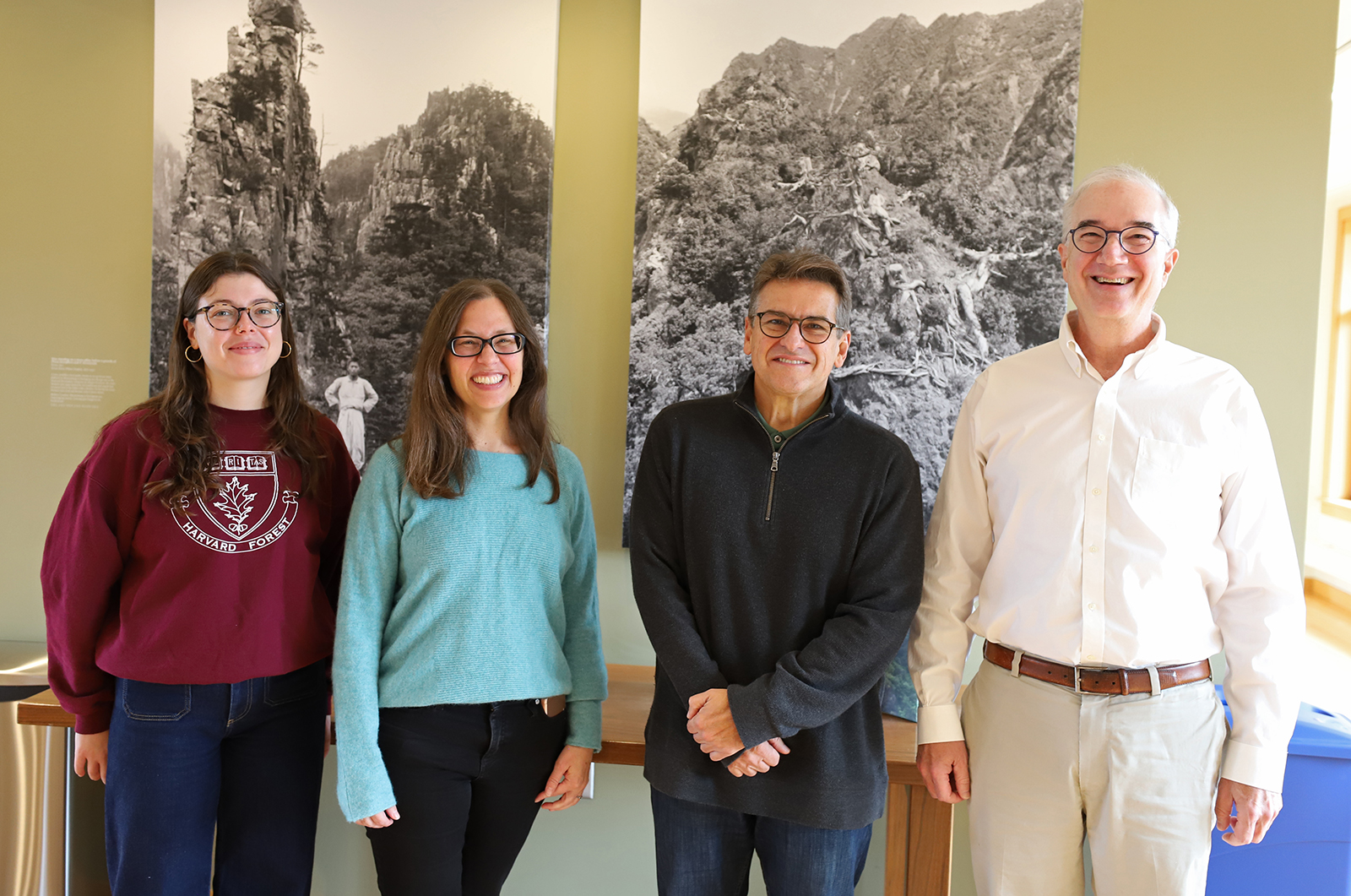
They have only just met, but already Paulo Carvão and Carina Berlingeri are swept away in conversation, uncloaking commonalities faster than I can decipher their Harvard jargon—like “PfoHo”, the nickname of a Harvard undergraduate residential house. Carina is an Arboretum research fellow and the inaugural recipient of the Maria Amalia Carvão Research Award, a fund for early-career scientists endowed by Paulo and his sons in memory of his wife. Paulo, an Arnold Arboretum member and Harvard Kennedy School Senior Fellow, has joined us for a tour of the Weld Hill Research Building and Carina’s ongoing research projects that have been partially funded by the Carvão Award.
“My wife’s interest was always plants,” Paulo shares. “She was a physician—very into science, and also in garden clubs and always outside cultivating her garden. Because of her passion for the environment and science, we thought this research award would be a good way to remember her.”
Now Paulo says he has “an indirect passion for plants,” but it’s clear he too appreciates science and the outdoors. As we pass an orchid that “slaps” bees, Paulo happily inserts his finger to test out the unusual biological mechanism. Later as we descend the stairs to the plant growth chambers where researchers can control the temperature, humidity, light, and gas conditions of plants, Paulo casually mentions being sore from running a half-marathon the day before.
He asks Carina thoughtful questions as she explains her work researching the partnership between root systems and mycorrhizal fungi. “As you learn more, could this work potentially lead to reduced use of fertilizer?” Paulo asks excitedly. Carina confirms that her research is beneficial for the future of agriculture and gardens all over the world. “If we can figure out how these root-fungi partnerships affect tree growth and nutrient cycling and what keeps the roots and mycorrhizal fungi in a mutual relationship, as opposed to a parasitic one, we can help plants grow in an increasingly changing climate.”
In a greenhouse room, Carina has rows of potted saplings that she uses for her research project titled Abiotic and Biotic Drivers of Mycorrhizal Associations. “Studying roots is hard because they are hidden away,” Carina explains. “They can only be measured and viewed under a microscope after lots of airspading [using compressed air to remove the soil without harming the roots].” This room allows her to conduct her research in a highly controlled environment, but she also has a separate but closely related project in the gardens outside the building, where we head next.
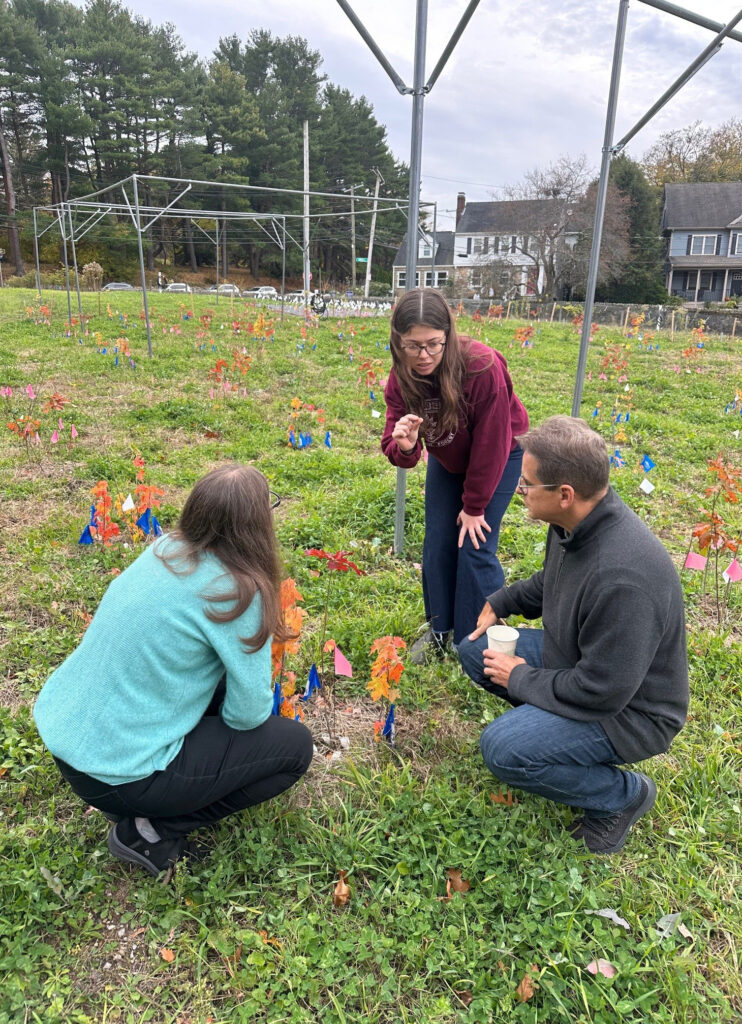
In the research growing beds, Carina gestures at the rows of baby oaks and maples, one- to two-year-old saplings clumped together every few feet. “This is all thanks to the award,” she shares, and begins an animated explanation of her second research project. The saplings are practically planted on top of one another, forcing the trees to be in close competition so their behavior with each other and mycorrhizal fungi can be analyzed. It is clear from her thorough and passionate tour that she is grateful for the opportunity to share her project with the person whose funding is making it possible.
With the tight budget of a graduate student, Carina credits the Carvão Award with her ability to do this second project. “Most grants are field based so I would have needed to study at sites that are flights away,” Carina explains. “Then I would have only gotten a snapshot and would not have also been able to teach at the same time.” At Weld Hill, she can do long-term research in the garden, while also conducting her other research project indoors and teaching classes in Cambridge. “I’m grateful for the unlimited free coffee and late-night security,” Carina quips of her busy schedule and long days in the lab.
These opportunities are exactly what Paulo and his sons had hoped for when creating the Carvão Award. With the Arboretum’s 281 acres of free landscape and rare living collections, the land abutting the Arnold Arboretum’s research building can be overlooked, but Paulo appreciates its importance as well as the incredible value of the researchers who work there. “Talent is everywhere,” Paulo shares. “However, not everyone has access to the resources to enable this talent to flourish. My sons and I are so pleased we can honor Maria’s legacy through the next generation of researchers.”
With substantial cuts to federal research grants in recent months, supporting scientific research is more critical now than ever. Even if these funds are reinstated, the fear of fickle funding lingers, and long-term research projects feel especially fragile. Furthermore, visas for international researchers are harder to procure, limiting the essential cross-pollination of scientific ideas and knowledge that can sometimes lead to groundbreaking discoveries.
As the tour concludes, Carina and Paulo are already making plans to meet again, fellow Harvard Fellows united by an award that is helping the memory of nature- and science-loving Maria live on through the nurtured science careers of future generations. Just like Maria used to tend to her beloved plants, the Maria Amalia Carvão Research Award is growing a “garden” of young scientists and scientific discovery, and Carina is the first planting. Like Maria, Carina also discovered her passion for plants through early memories in the garden, playing with soil and caring for plants. Since the annual award was only created in late 2024, Carina is proud to be the first-ever award recipient with many more early-career scientists to come.
If, like Paulo, you value science the Arboretum’s mission to educate the next generation of scientists, help us face current headwinds as an institution dedicated to science and education. Learn more about supporting the Arnold Arboretum’s research mission or make a gift today.